Family: Arcade, speed and sport
Rhythm AI game maker
A rhythm AI game maker has to make four-lane and piano legible before it adds features. Rhythm is a note, a lane and a window. This shelf has four-lane tap charts and a piano mode with 26 short melodies. 13 builds, original synthesized music, no licensed tracks and no chart editor.
What makes a rhythm game hold up?
A rhythm game is a timing test disguised as music. The note should arrive with the beat, the lane should be readable at speed, and the judgement should tell the player whether they were early or late. If the audio and the chart disagree, the game is a memory test.
This shelf is narrow. Finger Dance is a piano mode with 26 short synthesized melodies and highlighted keys. The Beat builds are four-lane tap charts with a combo and a fail state. The themes change, the lane grammar does not. None uses licensed music, and there is no chart editor or calibration screen.
That makes the shelf a good test of the first phrase. A model can describe a stage and a song. The shelf shows whether the notes land on the beat, whether a miss is legible and whether the restart keeps the player in the music.
Start with these builds
6 REAL BUILDS · NOT MOCKUPS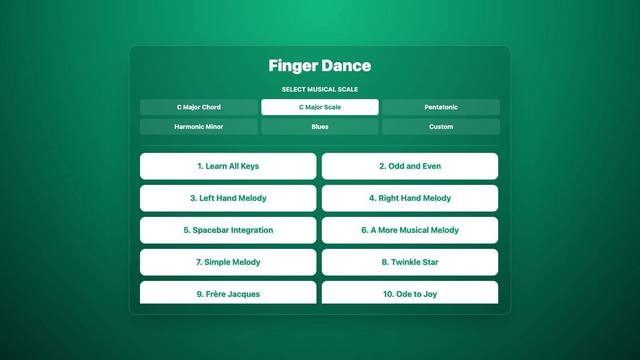
Finger Dance
2DTap the highlighted keys to play through 26 short, synthesized piano melodies.
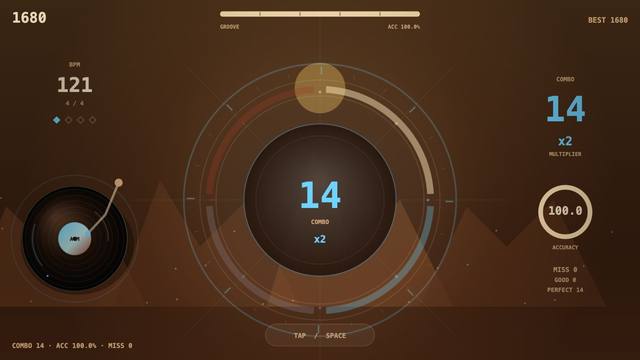
Dust Beat
2DTap four lanes on the beat while notes converge, and one dropped run ends the set
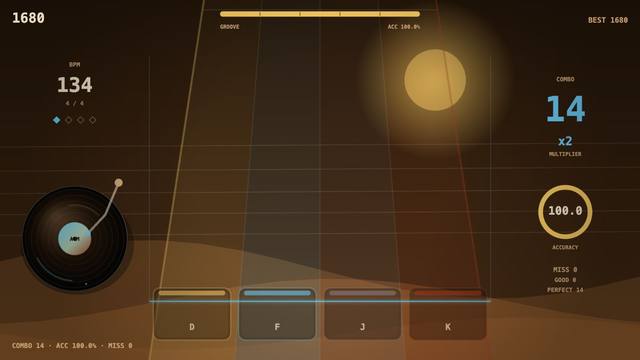
Dune Beat
2DNotes fall across four lanes while heat shimmer blurs the horizon; one missed beat ends the run.
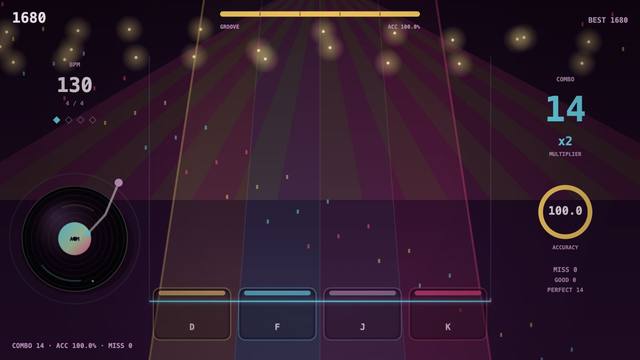
Midway Beat
2DRide four carnival lanes as notes drop past bulb gold and confetti, where a broken combo costs the run.
Dream Beat
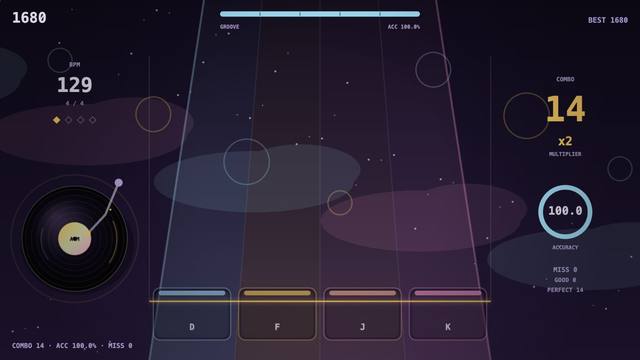
2DFour lanes of falling notes drift through pastel clouds, and each early press costs accuracy
Ocean Beat
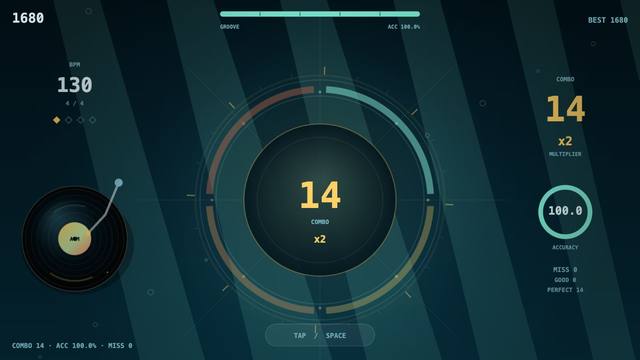
2DTap four lanes as notes converge out of deep water; a slipped beat breaks your combo and ends the run.
The six parts of a rhythm game
Use these checks when the brief depends on a chart and a timing window. They matter less for a music sandbox, where composition and free play carry more of the loop.
A beat map
The chart is the promise. Every note should have a reason to be on that beat; a random pattern is a reaction test.
A lane
The lane is the read. Four lanes are enough if the notes are spaced and the colors are distinct.
A timing window
The window tells the player how precise they were. Early and late should feel different, not just wrong.
A combo
A combo is the momentum. It should be visible without covering the notes, and a break should be clear.
An audio cue
The music is the clock. If the player has to watch a bar instead of hear the beat, the chart is doing the wrong job.
A fail state
A miss should end the run or cost a clear resource. A silent score reduction is not a rhythm game.
The full rhythm shelf
Browse all Rhythm matches →| Build | Genre | Input |
|---|---|---|
| Finger Dance | rhythm | keyboard or touch |
| Dust Beat | rhythm arcade | keyboard or touch |
| Dune Beat | rhythm arcade | keyboard or touch |
| Midway Beat | arcade rhythm | keyboard or touch |
| Dream Beat | rhythm | keyboard or touch |
| Ocean Beat | rhythm | keyboard or touch |
| Frost Beat | rhythm arcade | keyboard or touch |
| Lava Beat | rhythm arcade | keyboard or touch |
| Noir Beat | rhythm arcade | keyboard or touch |
| Ruin Beat | rhythm | mouse or tap |
| Neon Beat | music arcade | keyboard or touch |
| Castle Beat | rhythm arcade | keyboard or touch |
| Rooftop Beat | arcade rhythm | keyboard or touch |
| Pulsekin | rhythm | keyboard or touch |
| Earth FM | rhythm | keyboard or touch |
Swipe the table to see input.
Where an AI rhythm game generator stops
- Testing whether a four-lane chart reads.
- Comparing tap and piano modes.
- Finding the first phrase for a rhythm brief.
- Licensed music and a chart editor.
- Audio calibration and latency compensation.
- Online scores and a song library.
- Thirteen original synthesized charts.
- No licensed tracks or chart editor.
- No calibration screen or online leaderboard.
What rhythm tool pages promise
Tool pages promise generated songs, licensed tracks and a chart editor. A thirteen-build shelf cannot prove a music pipeline. It can show you whether a note lands on the beat, whether a miss is legible and whether the restart keeps the player in the music.
| Part | Tool pages promise | What this shelf gives you |
|---|---|---|
| Music | Licensed tracks and a chart editor. | Original synthesized tracks. No licensed music or chart editor. |
| Shelf scope | A claim to cover the whole genre. | Four-lane, piano, tap |
| What it cannot prove | A finished game in every mode. | Licensed music and a chart editor. |
Swipe the table to read all three columns.
How matching works
The matcher starts with “rhythm” and returns the closest playable build on this shelf. Read the matching method → Not sure which shelf fits?Open the genre map →
Three charts to compare
Finger Dance
A piano mode with 26 short melodies. Use it to test whether highlighted keys and a simple melody can carry a timing loop.
Play the build →Dust Beat
A four-lane tap chart with a fail state. Compare it with Finger Dance to see how much of rhythm is the lane read and how much is the song.
Play the build →Midway Beat
A carnival four-lane chart where a broken combo ends the run. It is the clearest test of whether a fail state adds tension or only punishment.
Play the build →Rhythm questions
What counts as a rhythm game here?
Four-lane, piano, tap — 13 builds in total. Thirteen original synthesized charts. No licensed tracks or chart editor. A rhythm game is a timing test disguised as music. Four-lane, piano, tap. Licensed music and a chart editor. Comparing tap and piano modes.
What is a rhythm AI game maker?
It is a shelf, not a generator. This shelf is narrow. Original synthesized tracks. No licensed music or chart editor. The matcher reads your brief and returns one build, so you can play the loop before you commission it. Four-lane, piano, tap
Can I make a rhythm game with AI?
You can brief one, but this page cannot generate it. Start with Finger Dance: A piano mode with 26 short melodies. Then write a spec; the part a model must prove is licensed music and a chart editor. Four-lane, piano, tap
Is there a rhythm game generator?
Not on this site. Tool pages promise: “Licensed tracks and a chart editor.” This shelf answers: “Original synthesized tracks. No licensed music or chart editor.” A generator can produce code or assets, but the hard part is audio calibration and latency compensation. Compare Finger Dance and Dust Beat first.
Are these rhythm games free?
Yes. All 13 builds run in the browser with no download and no signup; input is keyboard or touch. The shelf is for testing whether a four-lane chart reads. Paid remix and export are not open yet, so play Finger Dance before you commission one.
Do browser rhythm games work on a phone?
Most do. Input is keyboard or touch. No licensed tracks or chart editor. Finger Dance is the first build to try; Dust Beat is easier on a larger screen. Each game page lists controls before you start, so test on the device you will use.
Which rhythm games should I play first?
Start with Finger Dance: A piano mode with 26 short melodies. Then Dust Beat: A four-lane tap chart with a fail state. Midway Beat adds a third pressure. Two builds are enough to feel the range before you brief a model.
Sources and definitions
- Rhythm gameWikipedia: the genre and its chart-and-timing roots.
- MusicWikipedia: beat, tempo and the audio clock.
More shelves in this family
The Rhythm shelf covers Four-lane, piano, tap. Start with Arcade, then compare the rest of the family.