Part of the Idle shelf
Clicker game AI game maker
A clicker game AI game maker has to make the click, the purchase and the rate legible before it adds a long economy. A clicker is a number that goes up because you touched it. This shelf has eight: three original clickers plus five Fable-wave idles. Each adds a per-second economy and a short upgrade path.
What a clicker shelf has to prove
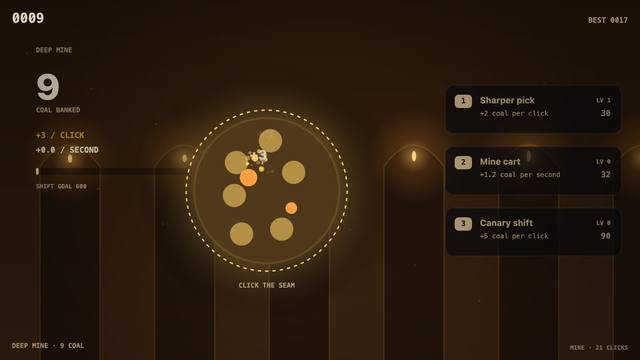
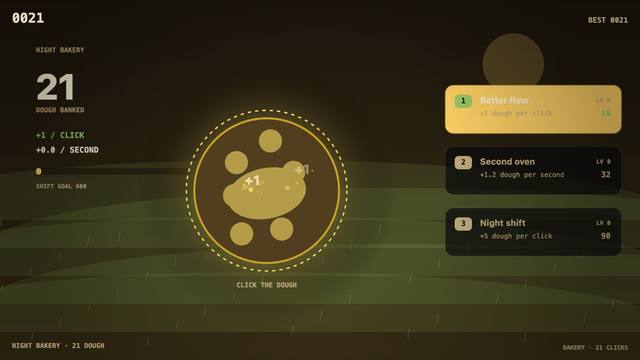
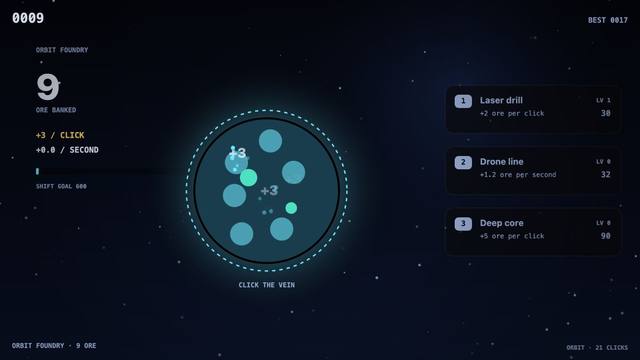
A clicker game is an economy with a hand on it. The first click should produce a number, the first upgrade should change that number, and the next upgrade should cost enough to make you choose. The 8 builds here share a click target, a per-second rate and three upgrades, then change the fiction. The three originals use a coal seam, a bakery counter and an orbital debris ring. The five Fable-wave builds move the same economy into an office, a bakery town, a warehouse, a bathhouse and a hamster colony.
The shelf can show whether a click, a purchase and a rate are legible. It cannot show offline progress, prestige layers or a hundred upgrades. These are short browser builds with a 600-point goal and an endless tail, not an idle game you leave running for a week. The limits section says so.
How we checked this shelf
- We played the three originals through the first two upgrades, checked the per-click and per-second numbers, and confirmed that the 600-point goal and the endless tail both resolve. The five Fable-wave builds were checked for load, input and goal state. We did not test a long-run economy.
The six parts of a clicker loop
Use these checks when the brief depends on a short economy and a visible upgrade. They matter less for a long-running idle game with offline progress.
A click that pays
The first touch should produce a visible number. If the player cannot tell whether the click registered, the loop never starts.
A rate you can read
Per-click and per-second income should be separate numbers. A single total hides the moment the economy starts working without you.
An upgrade with a cost
The first upgrade should be affordable after a short burst of clicks, and the second should cost enough to make you wait. A flat cost curve turns the game into a metronome.
A reason to stop clicking
Once the per-second rate carries the balance, the player should be choosing upgrades rather than tapping. That shift is the genre.
A goal and a tail
A 600-point target gives the short session a finish; the endless tail gives the economy room after it. A goal without a tail ends the game too early.
A fiction that fits
A coal seam, a bakery and an orbital ring should each change the names of the target and the upgrades. A reskin without new nouns is still the same build.
The full clicker shelf
Browse all Clicker Game matches →| Build | Genre | Input |
|---|---|---|
| Deep Mine | idle clicker | mouse or touch |
| Sugar Bakery | idle clicker | mouse or touch |
| Orbit Clicker | idle clicker | mouse or touch |
| Cosmic Intern | idle | mouse or touch |
| Sweet Town | idle | mouse or touch |
| Bubble Wrap Club | idle | mouse or touch |
| Scrub Master | idle | mouse or touch |
| Burrow Town | idle | mouse or touch |
Swipe the table to see input.
Where this shelf stops
- Scoping a click target, a per-second rate and a three-upgrade economy.
- Choosing a fiction that changes the target and the upgrade names before adding art.
- Checking whether the first purchase is visible and the goal is reachable.
- Offline progress, prestige resets or a long-term save.
- A hundred upgrades or a production chain; the builds have three upgrades each.
- Claiming a full idle game when the session is a short browser loop.
- Eight clicker builds with a 600-point goal and an endless tail.
- A per-click and per-second economy with three upgrades.
- No offline progress, prestige or persistent save.
What a clicker tool page promises
Tool pages sell an idle economy that runs while you are away. This shelf sells three short click loops you can finish in one sitting, with no offline progress or prestige layer.
| Part | Tool pages promise | What this shelf gives you |
|---|---|---|
| Session | Days of passive progress and offline income. | A short session with a 600-point goal and an endless tail. |
| Upgrades | Dozens of upgrades and a production tree. | Three upgrades per build, scaling at roughly 1.7×. |
| Prestige | Reset layers and permanent multipliers. | No prestige or reset layer. |
| Save | Cloud or local save with offline catch-up. | No persistent save; the session starts fresh. |
Swipe the table to read all three columns.
How matching works
The matcher starts with “clicker game” and returns the closest playable build on this shelf. Read the matching method → Not sure which shelf fits?Open the genre map →
Eight fictions, one economy
Start with the coal seam
Deep Mine is the clearest version of the loop: one pick, one coal count, one first upgrade. Use it to judge whether the click and the rate are legible.
Play the build →Then change the nouns
Orbit Clicker keeps the same economy but turns the target into orbital debris. It is the test of whether a fiction can carry the loop without new mechanics.
Play the build →Clicker Game questions
Is this an idle game?
It is a short clicker with a per-second economy, not a long-running idle game. There is no offline progress, prestige layer or persistent save. A clicker game generator would need offline progress and a save state; this shelf has neither.
How long is a session?
The first goal is 600 points. A short session can reach it in a few minutes; the economy keeps running after the goal. The first upgrade is cheap, the second asks for a choice, and the 600-point goal is reachable in one sitting.
How many upgrades are there?
Three per build. Each raises the click or per-second rate and costs roughly 1.7× the previous price. Each build has three: one raises the click, one raises the rate, and one does both at a higher price. The last is the real decision.
Does the game keep running when I close the tab?
No. The session ends with the tab. There is no offline income or saved state. There is no offline income, no saved timestamp and no catch-up when you return. The economy exists only while the page is open. That is the honest limit.
Can I play on a phone?
Yes. The click target and upgrade buttons accept touch; the layout is a fixed landscape board. The click target and upgrade buttons accept touch, but the three-column layout is fixed landscape. Portrait will crop the rate panel. Rotate before you start.
Why eight games?
Eight fictions are enough to compare the three originals with the five Fable-wave offices, towns and odd jobs on the same economy. The page is indexable because the shelf has eight builds. Eight fictions are enough to decide what you would ask for when you make a clicker game with AI.
Sources and definitions
- Wikipedia: Incremental gameClicker and idle-game context.
- Wikipedia: Game economyCost curves and resource loops.