Part of the Multiplayer shelf
Social deduction AI game maker
A social deduction AI game maker has to make the contradiction and the accusation legible before it adds a human table. Social deduction is a table of stories with one liar. This shelf has three single-player builds: a five-seat mafia table, a six-villager night vote and a small resistance cell. Read the alibis before you prompt one.
What a deduction shelf has to prove
Social deduction is usually a group game. This shelf is the single-player version: a set of suspects, a witness and an alibi that does not fit. The player reads the statements and accuses one suspect. The 3 builds share that loop but change the table size and the number of rounds: five seats, six villagers and a five-person cell.
The shelf can show whether a contradiction is legible, whether an accusation has a cost, and whether a short round ends with a clear result. It cannot show online multiplayer, voice chat, hidden roles for human players or a social pressure loop. These are single-player logic puzzles with a social fiction, not a party game. The limits section is explicit.
Start with these builds
3 REAL BUILDS · NOT MOCKUPS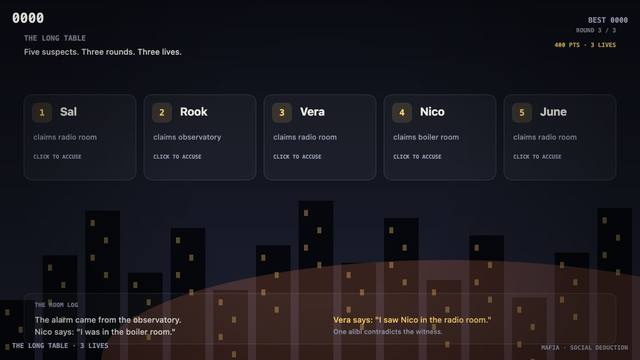
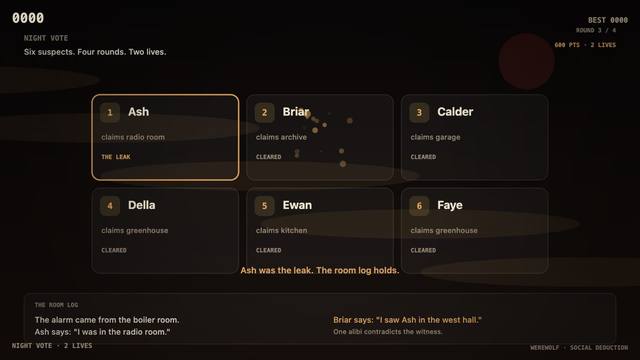
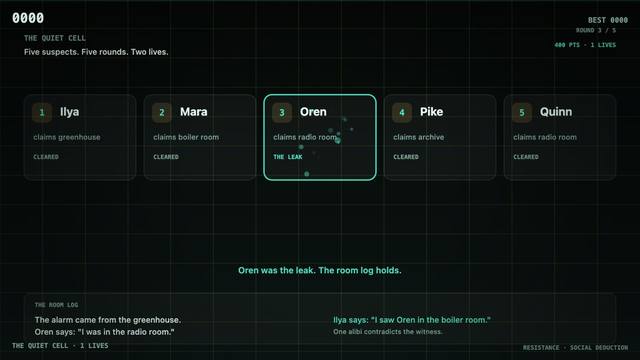
The six parts of a deduction table
Use these checks when the brief depends on a readable alibi and an accusation. They matter less for a live party game with human bluffing.
A table you can scan
Each suspect needs a name, a face and a statement in one card. If the player has to open a second panel to compare alibis, the deduction loop breaks.
A contradiction you can find
One alibi should conflict with the witness or the room log. The clue needs to be visible in the text, not hidden behind a hint button.
An accusation with a cost
A wrong accusation should cost a life or a round. Without a cost, the player can brute-force the table.
A round that ends
Correct or wrong, the round should resolve and show the culprit. A table that keeps asking for another accusation after the answer is a bug.
A table size that changes the read
Five, six and five suspects with different round limits should feel different. The extra card in the six-seat build adds one more alibi to compare.
A fiction without trademarks
Mafia, werewolf and resistance are genre names. The builds use their own tables and avoid claiming a licensed game or a show.
The full social deduction shelf
Browse all Social Deduction matches →| Build | Genre | Input |
|---|---|---|
| Table of Liars | social deduction | mouse or touch |
| Night Vote | social deduction | mouse or touch |
| Quiet Cell | social deduction | mouse or touch |
Swipe the table to see input.
Where this shelf stops
- Scoping a single-player deduction loop with suspect cards and a visible contradiction.
- Choosing a table size and a round limit before adding art or dialogue.
- Checking whether an accusation and a result are legible in one round.
- Online multiplayer, voice chat or human bluffing.
- Hidden roles, night actions or a social pressure loop.
- A large suspect roster or a branching mystery; the builds cap at six cards.
- Three single-player deduction builds with three lives.
- One culprit, one witness and a contradictory alibi per round.
- No online play, chat or human opponents.
What a social-deduction tool page promises
Tool pages sell a party game with friends, hidden roles and voice chat. This shelf sells a single-player logic puzzle with a social fiction. The difference is the table, not the theme.
| Part | Tool pages promise | What this shelf gives you |
|---|---|---|
| Players | A lobby of human players with hidden roles. | One player against a generated table of suspects. |
| Communication | Voice or text chat and live accusations. | No chat. Statements are pre-written and compared on cards. |
| Roles | Hidden roles, night actions and a moderator. | One culprit and one witness; no night phase. |
| Replay | A social metagame across sessions. | Short rounds with three lives; no persistent group. |
Swipe the table to read all three columns.
How matching works
The matcher starts with “social deduction game” and returns the closest playable build on this shelf. Read the matching method → Not sure which shelf fits?Open the genre map →
Three tables, three reads
Start with five seats
Table of Liars is the smallest table. Use it to check whether a suspect card, a statement and an accusation are readable before the six-seat build adds another alibi.
Play the build →Then add a seat
Night Vote uses six villagers and four rounds. The extra card is the test of whether the table still scans when one more story enters the comparison.
Play the build →Social Deduction questions
Is this a multiplayer game?
No. All 3 builds are single-player deduction puzzles. You read a generated table and accuse one suspect; there is no lobby, chat or human opponent. A social deduction game generator would need hidden roles for humans; this shelf is single-player.
What is the core loop?
Read the suspect statements, find the one that contradicts the witness or the room log, then accuse that suspect. A correct accusation earns points; a wrong one costs a life. The round is short because the table is small: read, compare, accuse, and live with the result.
How many suspects are there?
Five in Table of Liars, six in Night Vote and five in Quiet Cell. The six-seat build adds one more alibi to compare. The five-seat table is the cleanest read; the six-seat build adds one more alibi and one more chance to misread it.
Can I play on a phone?
The cards accept touch, but the layout is a fixed landscape board. A narrow screen will crop rather than reflow the table. The cards scroll and accept touch, but the fixed landscape table will crop in portrait. Read the alibis on a larger screen first.
Are these based on a specific party game?
They use the mafia, werewolf and resistance genre names but their own tables and text. They are not licensed adaptations and do not claim a show or a commercial game. The names are genre labels, not licensed rules; each build writes its own suspects and alibis.
Why only three games?
Three tables are enough to compare a five-seat read, a six-seat read and a smaller cell. The page stays noindex until a fourth deduction build is added. Three tables are enough to decide what you would ask for when you make a social deduction game with AI.
Sources and definitions
- Wikipedia: Social deduction gameGenre definition and party-game context.
- Wikipedia: Mafia (party game)Role and accusation conventions.