Part of the Card shelf
Poker AI game maker
A poker AI game maker has to make the paytable, the hold and the draw legible before it adds opponents. This is video poker, not a table with opponents. Three five-card draw builds put the paytable, the hold and the bet in front of you. Play a hand and see what the shelf can prove.
What a video-poker shelf has to prove
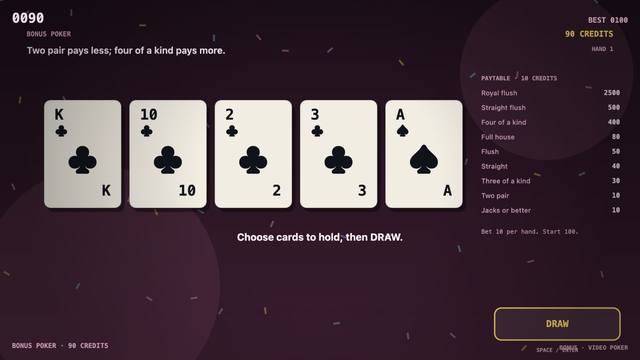
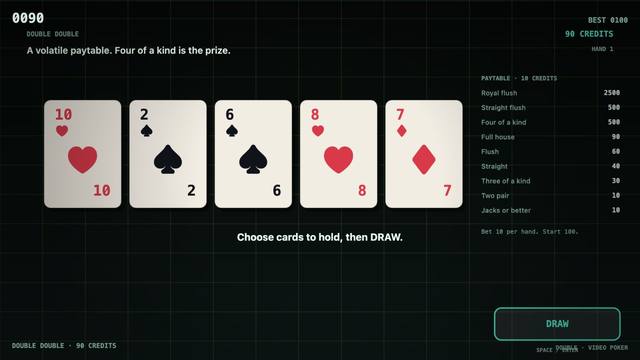
Video poker is a solitaire card game with a paytable. You are dealt five cards, choose which to hold, draw once, and get paid by the resulting hand. The interesting part is not the deal; it is the decision to hold a pair, chase a flush or throw the hand away. The 3 builds here use the same five-card draw but different paytables: Jacks or Better, Bonus Poker and Double Double.
A shelf of three cannot cover a casino floor. It can show whether the hold control is legible, whether the paytable matches the hand rankings, and whether a 100-credit bankroll makes the next bet feel like a choice. It cannot show a live opponent, a tournament or a real-money table. Those limits are deliberate.
Start with these builds
3 REAL BUILDS · NOT MOCKUPS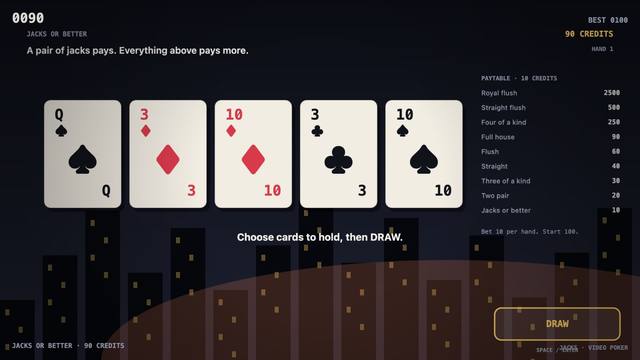
The six parts of a video-poker hand
These checks matter when the brief is about a paytable and a single draw. They matter less for a multiplayer poker table, which this shelf does not attempt.
A paytable you can read
The payout for a pair of jacks, two pair, trips, a straight and the rest should be visible before the first bet. The paytable is the rules.
A hold decision
Clicking a card should mark it as held, and the draw should replace only the cards you did not hold. A hold state you cannot see is a broken hand.
A bet with a floor
Ten credits per hand and a hundred-credit start gives the session a shape. The bet should be fixed and visible, not hidden behind a menu.
Hand ranking that matches
A flush should beat a straight, a full house should beat a flush, and four of a kind should pay what the table says. A wrong ranking breaks trust immediately.
Variance you can feel
Double Double pays more for quads and aces, which makes the dry spells longer. The paytable should tell you that before the bankroll does.
A clean end
When the credits run out, the hand should stop. A game that lets you keep drawing on an empty bankroll is not a game.
The full poker shelf
Browse all Poker matches →| Build | Genre | Input |
|---|---|---|
| Jacks or Better | video poker | mouse or touch |
| Bonus Poker | video poker | mouse or touch |
| Double Double | video poker | mouse or touch |
Swipe the table to see input.
Where this shelf stops
- Scoping a five-card draw loop with a visible paytable and a fixed bet.
- Comparing a low-variance paytable with a volatile one before choosing a theme.
- Checking whether hold, draw and hand ranking are understandable in one hand.
- Building a multiplayer poker table, a tournament or a bluffing opponent.
- Claiming real-money play; the builds use credits only.
- Guaranteeing a positive return or a profitable strategy from three paytables.
- Three video-poker builds with different paytables.
- A visible hold/draw flow and a 100-credit bankroll.
- No opponents, no tournaments and no real money.
What a poker tool page promises
Tool pages blur video poker, Texas Hold'em and a casino platform. This shelf is only the first: three single-player draw games with paytables, no opponents and no money.
| Part | Tool pages promise | What this shelf gives you |
|---|---|---|
| Format | Texas Hold'em, Omaha and a live table. | Five-card draw video poker only. No community cards and no betting rounds. |
| Opponent | AI or human opponents to read. | No opponent. The paytable is the only opposition. |
| Money | Real-money or sweepstakes framing. | Credits only: 100 start, 10 per hand, no cash value. |
| Strategy | A solver or a hand-history review. | No solver. You read the paytable and choose the hold. |
Swipe the table to read all three columns.
How matching works
The matcher starts with “video poker” and returns the closest playable build on this shelf. Read the matching method → Not sure which shelf fits?Open the genre map →
Three paytables, three risk profiles
Start with the baseline
Jacks or Better is the cleanest paytable in the set. Use it to check whether the hold control and the hand ranking are readable before you chase a bigger payout.
Play the build →Then feel the variance
Double Double pays more for quads and aces, so the dry spells last longer. It is the build that shows whether the bankroll and the bet size tell the truth about risk.
Play the build →Poker questions
Is this a poker game with opponents?
No. These are single-player video-poker builds. You are dealt five cards, choose holds and draw once; there is no opponent, bluffing or betting round. There is no table, no dealer and no bluff; the only decision is which cards to hold before the draw.
Does the game use real money?
No. Each build starts with 100 credits and bets 10 per hand. The credits have no cash value and there is no purchase path. The 100-credit bankroll is a closed loop; when it runs out, the build resets rather than opening a purchase path.
What is the difference between the three paytables?
Jacks or Better is the baseline. Bonus Poker shifts value toward four of a kind. Double Double pays more for quads and aces but is more volatile. Jacks or Better pays a pair of jacks; Bonus pushes value to four of a kind; Double Double adds aces and twos.
Can I play on a phone?
The card row and buttons accept touch, but the layout is a fixed landscape table. A narrow phone will crop rather than reflow the hand. The hold buttons accept touch, but the five-card row is fixed and will crop in portrait.
Is there a strategy guide or solver?
No. The shelf shows the paytable and the hold/draw loop; it does not grade your decisions or calculate expected value. A poker game generator would also have to grade the hold; this shelf only shows the loop. It does not score your holds or show expected value, so the paytable is the only guide.
Why only three games?
Three paytables are enough to compare a baseline, a bonus table and a volatile table. The page stays noindex until a fourth build is added. Three paytables are enough to decide what you would ask for when you make a poker game with AI.
Sources and definitions
- Wikipedia: Video pokerDraw, hold and paytable conventions.
- Wikipedia: PokerCard-game family context.