Part of the Board shelf
Chess AI game maker
A chess AI game maker has to make the legal move obvious before it adds a stronger opponent. Chess is a board, a legal-move rule and an opponent. This shelf has 3 builds: a clean untimed game, a three-minute blitz and a set of mate-in-one puzzles. Play the board before you prompt one.
What a chess shelf has to prove
A chess page has one job: make the legal move obvious and the illegal move impossible. The board can be plain, but the rule set cannot. The 3 builds here share an 8x8 board and a greedy house opponent, then split the pressure. Classic removes the clock. Blitz gives you three minutes. Mate in One turns the board into three endgames with a single winning move.
The shelf is honest about its opponent. The house AI is a depth-one greedy player, not an engine. There is no castling, en passant or underpromotion, and no online opponent. Those omissions matter if you need a chess product; they matter less if you need to see whether a board and a legal-move layer are legible. The limits section says which is which.
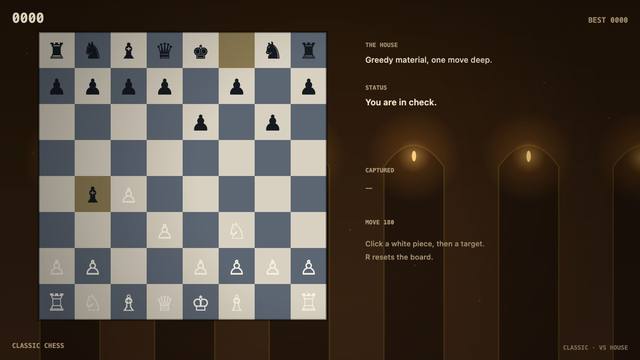
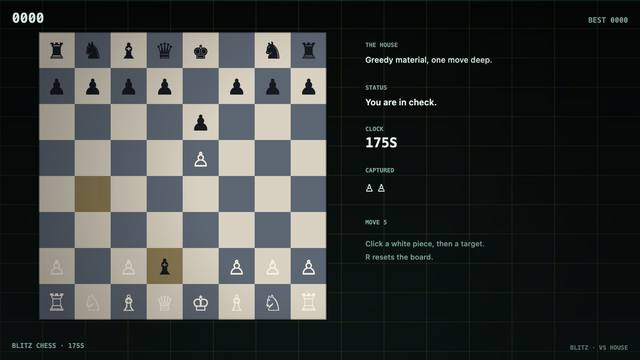
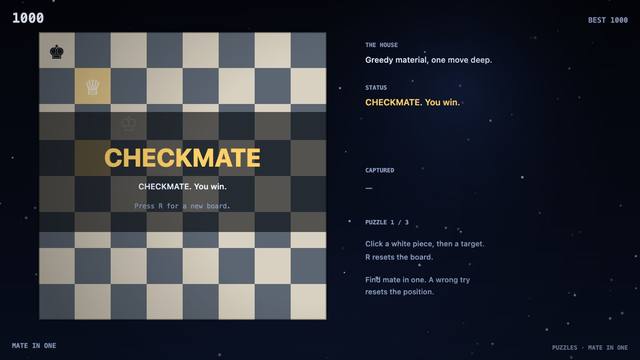
The six parts of a chess board
Use these checks when the brief depends on a readable board and a legal move. They are not a checklist for engine strength or tournament rules.
A board you can read
Sixty-four squares, two colours and pieces that stay distinguishable at a glance. The board should not need a legend before the first move.
Legal moves only
A move that leaves your king in check should be refused. The rule set is the game; a board that accepts an illegal move is a drawing, not chess.
An opponent with a shape
The house opponent should capture, block and take a free piece. It does not need to be deep, but it needs to make a move you can understand.
A clock or a puzzle
Blitz adds three minutes; Mate in One removes the clock and gives you a single winning move. The mode should change the decision, not just the decoration.
Promotion that resolves
A pawn reaching the last rank should become a queen and stay on the board. A promotion that asks a question mid-move breaks the flow.
A finish you can see
Checkmate, a lost king or a solved puzzle should stop the board. A silent finish is a bug.
The full chess shelf
Browse all Chess matches →| Build | Genre | Input |
|---|---|---|
| Chess Classic | chess | mouse or touch |
| Blitz Chess | chess | mouse or touch |
| Mate in One | chess puzzle | mouse or touch |
Swipe the table to see input.
Where this shelf stops
- Scoping an 8x8 board with legal-move filtering and a visible check state.
- Choosing between an untimed game, a clock and a puzzle set before adding art.
- Checking whether a beginner can read the board and make a legal move.
- Building a strong chess engine; the house AI is depth-one and greedy.
- Tournament rules: castling, en passant and underpromotion are not implemented.
- Online play, ratings, analysis or a puzzle database.
- Three chess builds with a shared legal-move layer.
- One untimed game, one 180-second blitz and three mate-in-one puzzles.
- No engine strength, no online opponent and no tournament rule set.
What a chess tool page promises
Tool pages sell an engine, a rating and a full rule set. This shelf sells three boards you can open now. The difference is the opponent and the rulebook, not the size of the grid.
| Part | Tool pages promise | What this shelf gives you |
|---|---|---|
| Opponent | A rated engine or online players. | A depth-one greedy house AI. No online play and no rating. |
| Rules | Full FIDE rules, including castling and en passant. | Legal moves and check, but no castling, en passant or underpromotion. |
| Training | Puzzle databases, analysis and opening prep. | Three mate-in-one positions, no analysis or hint system. |
| Clock | Custom time controls and increments. | Untimed or a fixed 180-second blitz. |
Swipe the table to read all three columns.
How matching works
The matcher starts with “chess” and returns the closest playable build on this shelf. Read the matching method → Not sure which shelf fits?Open the genre map →
Three ways to test the board
Start without a clock
Classic is the reference board. Use it to check whether the legal-move filter and the check state are readable before the clock adds pressure.
Play the build →Then test the endgame
Mate in One removes the opponent's plan and asks for a single move. It is the quickest way to see whether the board makes a winning line visible.
Play the build →Chess questions
Is this a chess engine?
No. The house opponent is a depth-one greedy player. It captures and blocks, but it is not a rated engine and it does not search deeply. A chess game generator would need a deeper search; this shelf is a board test.
Does the game support castling or en passant?
No. The builds implement legal moves and check, but not castling, en passant or underpromotion. Pawns auto-promote to a queen. Those rules are omitted on purpose: the build tests a legal-move layer, not tournament completeness. Pawns still promote, but only to a queen.
What is Mate in One?
A puzzle mode with three fixed positions. Each has a single move that delivers checkmate; the board stops when you find it. The three positions are fixed, so you can replay the same mate until the pattern is obvious. There is no hint button.
Can I play against a friend?
No. All 3 builds are single-player against the house. There is no online play, pass-and-play or local two-player mode. The shelf is single-player only; there is no pass-and-play, local board or online seat. Classic and Blitz are both against the house.
Can I play on a phone?
The board accepts touch, but the layout is a fixed landscape board. A narrow screen will crop rather than reflow the squares. The squares accept touch, but the board is landscape and will crop in portrait. Blitz is the harder test because the clock shrinks the tap target.
Why only three games?
3 builds cover an untimed game, a clock and a puzzle set. The page stays noindex until a fourth chess build is added. 3 builds are enough to decide what you would ask for when you make a chess game with AI.
Sources and definitions
- Wikipedia: ChessRules and piece movement.
- Wikipedia: CheckmateMate patterns and puzzle context.