Part of the Arcade shelf
Stacker AI game maker
A stacker AI game maker has to make precision stack and one-button riser legible before it adds features. A stacker is a timing test with a visible height. This shelf has 19 builds: clean precision towers, one-button risers and a few tower-defense hybrids that borrow the stacking verb. Play the first ten drops before you ask a model to invent one.
What a stacker shelf has to prove
The loop is small: a block moves, the player drops it, and the next block starts from the new edge. The interesting part is how the game communicates the loss of precision. Some builds narrow the block, some move the camera, and some turn the tower into a lane defense where the stack is also the wall.
A shelf this size can show whether the drop timing is readable and whether a miss feels like a mistake. It cannot show a long meta progression, daily challenges or a hand-tuned difficulty curve across fifty levels. Those are production layers, not a prompt.
Start with these builds
6 REAL BUILDS · NOT MOCKUPS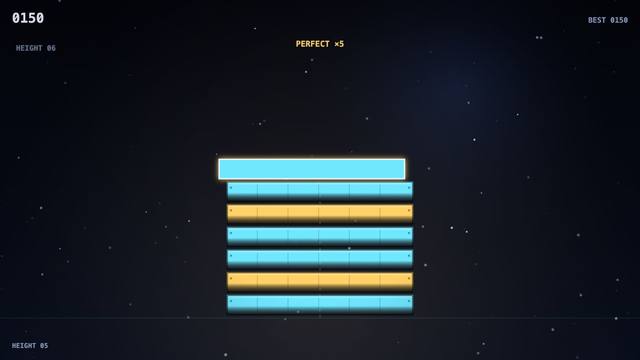
Station Stack
2DDrop sliding blocks onto an orbital tower while wind pushes them off line; every near-perfect landing widens your margin.
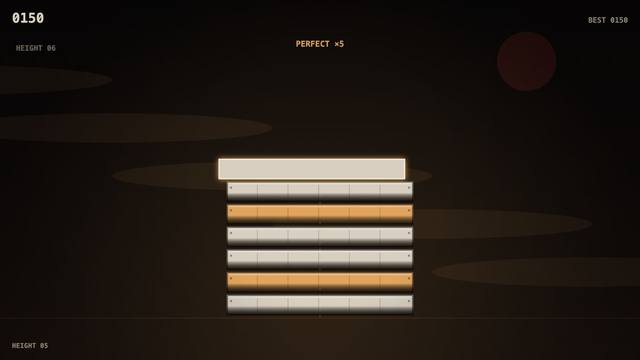
Bone Tower
2DA candle-lit block sways in the wind above a bone tower; tap to drop before the drift costs you the edge.
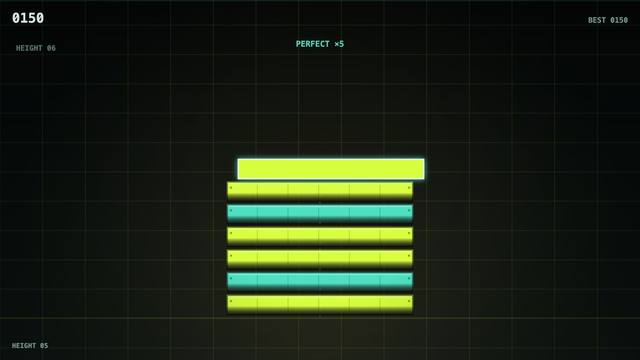
Server Stack
2DStack black-glass server blocks under scanlines while crosswind nudges each one; the tower stays square only if you correct early.
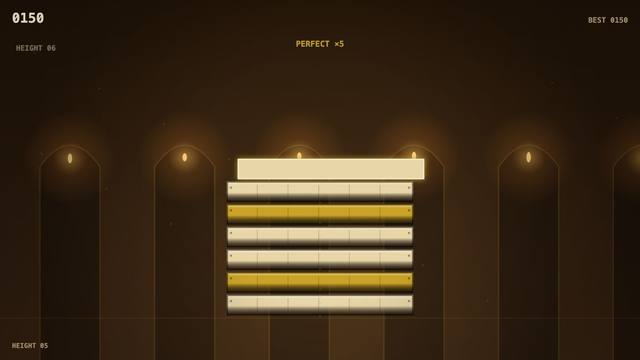
Keep Rising
2DBronze-capped blocks slide above heavy stone arches and the wind leans them; one press sets each course.
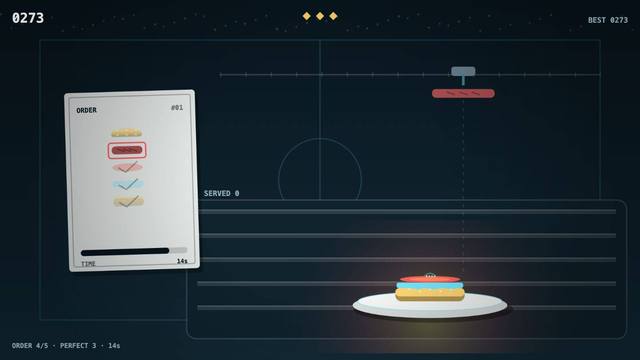
Stack Grill
2DA tray slides back and forth under each order item; tap on the line to stack it clean before the pile topples.
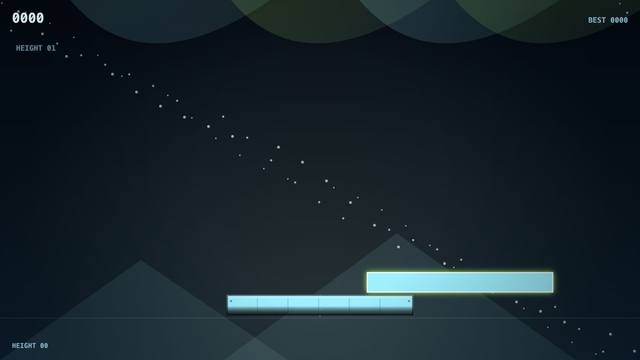
Ice Keep
2DDrop each sliding block onto the ice tower and trim the overhang before the stack leans past recovery.
The six parts of a stack
Use these checks when the brief is a pure timing game. They matter less for a tower-defense hybrid where the stack is a defensive line rather than the whole loop.
A readable drop line
The player needs to see where the block will land before committing. A moving shadow or a fixed guide is enough; a busy background is not.
A fair overlap rule
The game must decide what counts as a miss. A sliver of overlap that still counts teaches the player to distrust the edge.
A speed step you can hear
The riser gets faster, but the player needs a cue before the next step. Audio, color or a short pause can carry the change.
A height worth chasing
The score needs a shape: meters, floors or a visible skyline. A bare number is less satisfying than a tower that changes silhouette.
A restart that preserves rhythm
A stacker is played in short runs. The restart should return the player to the same ready state without a long menu.
A reason to look up
The next block should enter from a direction the player can track. A camera that jumps between floors breaks the timing read.
The full stacker shelf
Browse all Stacker matches →| Build | Genre | Input |
|---|---|---|
| Station Stack | arcade stacker | keyboard or touch |
| Bone Tower | horror arcade | keyboard or touch |
| Server Stack | reflex arcade | keyboard or touch |
| Keep Rising | arcade stacker | keyboard or touch |
| Stack Grill | order stacking arcade | keyboard or touch |
| Ice Keep | arcade stacker | mouse or tap |
| Coral Spire | arcade stacker | keyboard or touch |
| Haystack | stacker | keyboard or touch |
| Skyscraper | arcade stacker | keyboard or touch |
| Canopy Stack | one-button stacker | keyboard or touch |
| Macaron Tower | casual arcade | keyboard or touch |
| Podium Stack | arcade | keyboard or touch |
| Dune Spire | stacker | mouse or tap |
| Magma Keep | arcade stacker | mouse or tap |
| Precinct Tower | arcade stacker | mouse or tap |
| Ruin Spire | arcade stacker | mouse or tap |
| Midway Tower | arcade stacker | mouse or tap |
| Mesa Keep | arcade stacker | mouse or tap |
| Dream Spire | arcade stacker | mouse or tap |
| Flatpack | puzzle | mouse or touch |
Swipe the table to see input.
Where an AI stacker game generator stops
- Scoping a first stacker around one drop verb and one speed curve.
- Comparing precision, one-button and hybrid structures.
- Testing whether a near miss reads as fair.
- Building a long level campaign or daily challenge system.
- Adding cosmetics, currencies or a meta progression layer.
- Proving retention without real player data.
- Seventeen short browser towers with visible scores and restarts.
- No level editor, save system or monetization layer.
- No claim that any build is a complete commercial stacker.
What stacker tool pages promise
Stacker tools usually promise a tower from a prompt. This shelf shows what the drop actually feels like when the block is moving.
| Part | Tool pages promise | What this shelf gives you |
|---|---|---|
| Drop feel | A prompt can describe timing and precision. | Every build lets you test the drop before you commit. |
| Difficulty | Often a settings promise, not a playable curve. | You can feel where the speed steps up and where it breaks. |
| Content volume | Generation can produce tower variants quickly. | Each build is a short run, not a campaign of towers. |
| Full game | A tool may promise a complete arcade game. | These are prototypes and small arcade runs, not full products. |
Swipe the table to read all three columns.
How matching works
The matcher starts with “stacker stacking tower” and returns the closest playable build on this shelf. Read the matching method → Not sure which shelf fits?Open the genre map →
Stacker questions
What counts as a stacker game here?
Stacker here is a block that moves, a drop and a new edge. 19 builds cover precision towers, one-button risers and a few hybrids where the stack is also a wall. There is no level editor, save file or currency, so the shelf tests whether a near miss reads as fair.
What is a stacker AI game maker?
The page is a seventeen-tower shelf, not a difficulty generator. Each build shows its own speed step and its own way of marking the landing edge. The matcher returns one tower from your brief, and you drop ten blocks before you ask a model to build a campaign.
Can I make a stacker game with AI?
Play Station Stack and watch the first three drops. The landing edge should be the only information you need; if the camera hides it, the timing is not yet legible. Write that as the brief's first test. A model can add levels later, but it cannot tune a speed curve it has never felt.
Is there a stacker game generator?
No generator on this page. A tool page can describe a precision loop; the shelf shows seventeen short runs and the exact block where the tower breaks. The missing part is the long campaign, the daily challenge and the cosmetics layer, and those are production choices rather than prompt settings.
Are these stacker games free?
Every tower is a free browser build. No account, no download and no ad gate; keyboard and touch both work. Remix and export are not open yet. Play Station Stack first, because the shelf is for testing a drop, not for replacing an arcade game with a progression system.
Do browser stacker games work on a phone?
They work on a phone with touch, and a short drop fits a small screen. Station Stack is the best first test because the landing edge is visible; Bone Tower is easier on a larger screen when the next block stays in frame. Check the tap timing before you judge it.
Which stacker games should I play first?
Start with Station Stack, then Bone Tower. The first shows a clean precision tower; the second shows a horror frame that keeps the block visible. Server Stack adds a third speed. Two towers are enough to see whether the shelf is testing precision or just a skin.
Sources and definitions
- Stacking gameContext for the drop-and-overlap loop.
- Arcade gameShort-session score structure.