Part of the Arcade shelf
Reaction Game AI game maker
A reaction-game AI game maker has to make the signal, the window and the miss readable before it adds speed. This shelf has 32 builds: runners, one-button flyers, timing taps, stackers, tennis rallies and a freeze-on-red-light test. Play one before you ask a model to invent a reflex game.
What a reaction-game shelf has to prove
The first question is whether the player can see the moment to act. Red Light turns on a signal and punishes an early move; Ion Sprint asks for a jump and then a second tap; Timber keeps the axe on a fixed rhythm. The 32 builds split between continuous movement, one-button timing and short precision rounds.
A shelf can show whether the window is visible, whether a miss is the player fault and whether the next attempt starts fast. It cannot show a difficulty curve tuned over months, a ghost replay or a leaderboard. Those are live-ops and tuning problems.
The shelf is 28 2D builds and four 3D builds: 28 use keyboard or touch, two use mouse or tap, and two use keyboard or mouse.
How we checked this shelf
- We checked every build in the table against the shelf gate: licence clear, loads clean, input works, loop starts, controls documented, and the page holds at 1440 px and 390 px.
- We counted a build as a reaction game only when the core decision is when to act; speed alone is not enough. Shooters with reflex tags stay in the count, but the featured six are timing-first loops.
- The 32-build count includes runners, flyers, stackers, timing taps, tennis rallies and one freeze-on-red-light test. It is not a claim that all 32 train the same skill.
- We checked the table against the build catalog on 23 November 2026; the input split is read from each build’s control field.
Shelf check log
| Build | What we ran |
|---|---|
| Ion Sprint | Title → playing after Space; run clock +2.37 s; score 24.49; 0 console/network errors. |
| Undertow Run | Title → playing after Space; run clock +2.35 s; score 24.32; 0 console/network errors. |
| Brick District | Title → playing after Space; run clock +2.23 s; score 16.12; 0 console/network errors. |
Sample, not a full regression: three builds per shelf were loaded from the static build. Each moved from the title screen to playing after Space or a click, advanced its run clock and logged no console or network errors. Scores are whatever the build produced during the smoke test, not a skill rating.
Start with these builds
6 REAL BUILDS · NOT MOCKUPS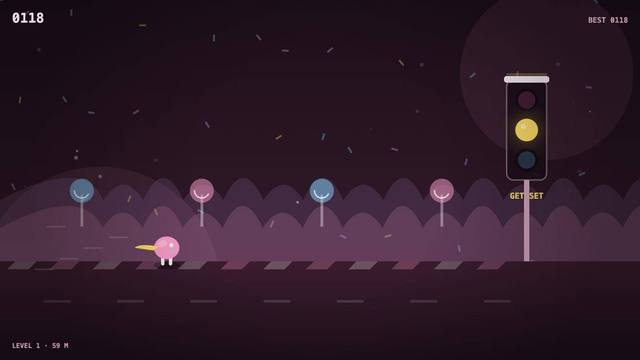
Red Light
2DAdvance across a pastel candy floor and freeze on the red light, because moving at the wrong moment ends the run.
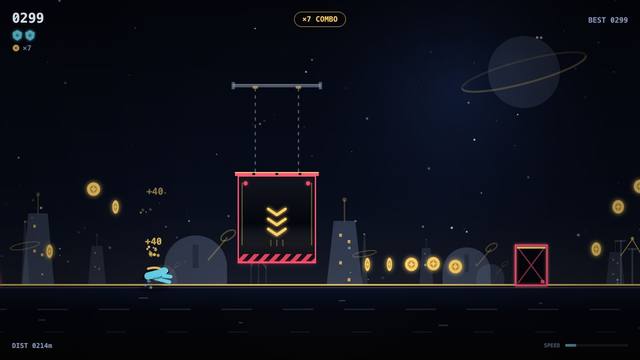
Ion Sprint
2DJump and double jump through cold starfields as the orbital rings close in faster than your timing.
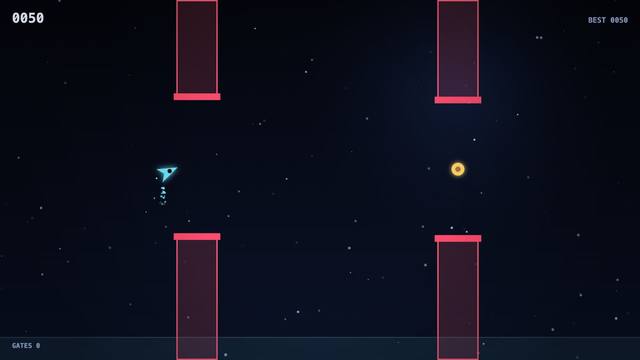
Hull Breach
2DEach tap lifts the craft against gravity; gates close in, and one contact ends the run.
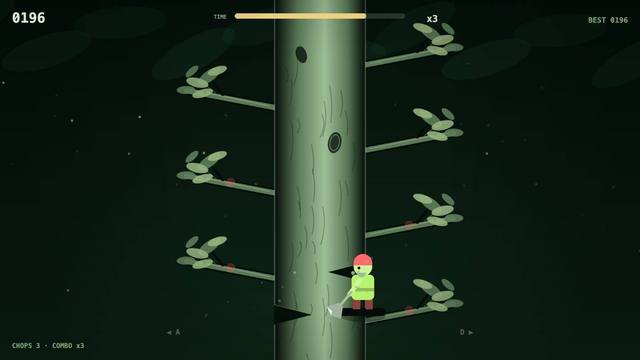
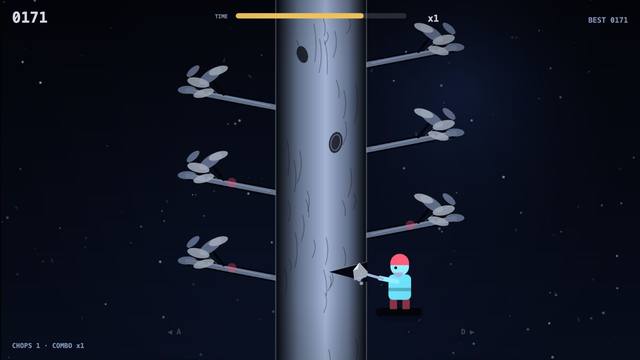
Timber!
2DTime each axe swing as the blade sweeps past the mark, because one early tap ends the run.
Countdown Bay
2DA launch complex with one rocket, a narrow window, and a control room full of switches that all need the same second. Time the sequence, hold the pressure, and do not blink at T-minus three.
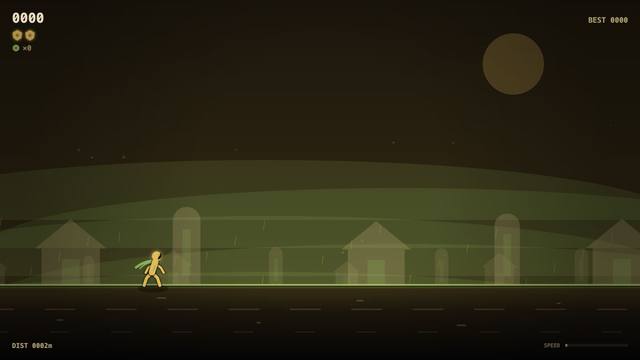
Maple Dash
2DAn orchard road in late autumn, running between falling leaves and stacked crates. Jump the cart ruts, duck the branches, and keep the pace up as the light goes.
The six parts of a reaction game
Use these checks when the brief depends on when the player acts. They matter less for a game where speed is only a difficulty setting.
A signal you can see
The cue should arrive before the window, not at the same time. A signal that appears with the hazard turns reaction into memorisation.
A window you can feel
The timing window needs a visible or audible edge. A combo meter or a shrinking bar is enough if the player can read it at speed.
A miss that is yours
A failed attempt should follow from the input, not from a hidden rule. The player should be able to name the mistake in one sentence.
A restart that is instant
Short rounds need a one-input retry. A menu between attempts breaks the rhythm that makes a reaction game work.
A score that tracks the run
Distance, combo or precision should match the skill being tested. A score that rises with time alone is a clock.
A finish that is distinct
A collision, a missed window and a failed stop should look different. One generic game-over screen hides what to fix.
The full reaction game shelf
Browse all Reaction Game matches →| Build | Genre | Input |
|---|---|---|
| Red Light | reaction arcade | keyboard or touch |
| Ion Sprint | endless runner | keyboard or touch |
| Hull Breach | arcade | keyboard or touch |
| Timber! | single-button timing arcade | keyboard or touch |
| Countdown Bay | timing | keyboard or touch |
| Maple Dash | endless runner | keyboard or touch |
| Undertow Run | endless runner | keyboard or touch |
| Brick District | brick breaker | keyboard or touch |
| Cellar Flap | horror arcade | keyboard or touch |
| Dragon Gate | medieval arcade | keyboard or touch |
| Air Bubble | ocean arcade | keyboard or touch |
| Server Stack | reflex arcade | keyboard or touch |
| Canopy Stack | one-button stacker | keyboard or touch |
| Sky Canvas | sky glider arcade | keyboard or touch |
| Icebound Hop | gravity flip platformer | keyboard or touch |
| Ice Tap | one-button arcade | keyboard or touch |
| Polar Rally | tennis arcade | mouse or tap |
| Night Tennis | sports arcade | mouse or tap |
| Dream Maze | maze chase | keyboard or touch |
| Vector Run | endless runner | keyboard or touch |
| Dune Dash | endless runner | keyboard or touch |
| Frostline Run | endless runner | keyboard or touch |
| Orbit Runner | arcade flight | keyboard or touch |
| Starlit Ride | endless runner | keyboard or touch |
| Clay Behind You | reflex shooter | keyboard or mouse |
| Courier Line | endless runner | keyboard or touch |
| Ring Toss Night | carnival game | keyboard or touch |
| Sunset Airmail | flight | keyboard or touch |
| The Leer | reflex shooter | keyboard or mouse |
| Evening Post | flight | keyboard or touch |
| Chimney Run | arcade flight | keyboard or touch |
| Spillway | flight | keyboard or touch |
Swipe the table to see input.
Where a reaction game maker stops
- Scoping one signal and one window with a fast restart.
- Comparing continuous runners, one-button flyers and timing taps.
- Checking whether a miss is readable.
- Tuning a fair difficulty ramp across minutes.
- Building ghost replays, leaderboards and daily runs.
- Guaranteeing the same feel at every frame rate.
- Thirty-two short browser builds.
- No leaderboard, ghost or daily challenge.
- No claim that one build is a full reflex training product.
What reaction game tool pages promise
Tool pages promise a reflex test from a prompt. This shelf shows what the signal, the window and the retry actually do.
| Part | Tool pages promise | What this shelf gives you |
|---|---|---|
| Reaction tuning | A prompt can ask for increasing speed. | Each build has one fixed ramp; you can feel where it breaks. |
| Fairness | Rarely specified in the promise. | Signals are visible; misses come from timing, not hidden rules. |
| Retry | Usually not mentioned. | Every build restarts in one input, often the same button. |
Swipe the table to read all three columns.
How matching works
The matcher starts with “reaction game” and returns the closest playable build on this shelf. Read the matching method → Not sure which shelf fits?Open the genre map →
Reaction Game questions
What counts as a reaction game here?
Reaction game here means a build where the core decision is when to act: 32 of them. That includes endless runners, one-button flyers, timing taps, stackers, tennis rallies and a freeze-on-red-light test. Shooters with reflex tags are included, but the featured shelf stays on timing-first loops.
What is an AI game maker for reaction games?
This is a reference shelf, not a reflex trainer. Thirty-two builds let you compare how a signal is shown and how quickly a miss resets. The matcher points to the closest loop so you can test the window before writing a brief.
Can I make a reaction game with AI?
Pick Red Light for a discrete signal, Ion Sprint for a two-tap runner, or Timber for a rhythm window. Note the warning, the window and the restart time. Those three numbers are the brief; a model can add art once the timing is fair.
Is there a reaction game generator?
There is no generator here. A tool page can promise adaptive reaction tests; the shelf shows fixed ramps, a visible signal and a one-input restart. That is enough to judge whether the game is testing reaction or memorisation.
Are these reaction games free?
All 32 builds are free to play, with no account or download. They range from five-second timing taps to multi-minute runners. Start with a short one; a long run hides a bad window behind travel time.
Do reaction games work on a phone?
Most builds use tap or one button, so they travel well to a phone. Runners with three lanes need a wider screen; timing taps are the better small-screen test. Check that the tap target is not under your thumb.
Which reaction game should I play first?
Play Red Light, then Timber, then Ion Sprint. The first is a discrete stop-start, the second is a rhythm window, the third is a continuous dodge. Three attempts show whether the shelf is about reaction or pattern memory.
Sources and definitions
- Reaction timeThe measurement tradition behind reaction tests.
- Endless runnerThe continuous branch that supplies many builds here.
- Action gameThe wider genre built on timing and response.