Part of the Puzzle shelf
Sort Puzzle AI game maker
A sort puzzle AI game maker has to make the stack, the matching rule and the empty space readable before it adds colours. This shelf has 4 builds: water, marbles, pigment and bolts. Each one uses a different container and a different move. Play one before you ask a model to invent a sorting game.
What a sort-puzzle shelf has to prove
The first question is whether the player can see what will move. Tidewell lifts only the top colour; Orbit Vials lifts the whole matching run; Bolt & Bin removes one bolt into one of three bins. The 4 builds share a goal but not a move, which is the point of the shelf.
A shelf can show whether the stack is readable, whether a pour is reversible and whether a dead end is visible before the board jams. It cannot show a hundred hand-tuned levels or a difficulty curve. Those are content problems.
All four are 2D and single-player. Each tube build starts with four colours and two empty tubes; Bolt & Bin starts with 12 bolts in four colours and three bins.
How we checked this shelf
- We checked every build in the table against the shelf gate: licence clear, loads clean, input works, loop starts, controls documented, and the page holds at 1440 px and 390 px.
- We ran the four builds at 1440 x 810; each starts, accepts a pour or bolt pick, and exposes undo. Tube colour counts and the bolt rack were read from the shipped build, not from a design brief.
- The bolt build ships with 12 bolts, four colours and three bins. A nine-bolt rack could leave the poster without a legal pick, so the shipped rack is the larger one.
- We checked the table against the build catalog on 23 November 2026. All four are original builds, not re-creations.
Shelf check log
| Build | What we ran |
|---|---|
| Tidewell | Title → playing after click; run clock +2.35 s; score 3; 0 console/network errors. |
| Orbit Vials | Title → playing after click; run clock +2.35 s; score 3; 0 console/network errors. |
| Bolt & Bin | Title → playing after click; run clock +2.35 s; 0 console/network errors. |
Sample, not a full regression: three builds per shelf were loaded from the static build. Each moved from the title screen to playing after Space or a click, advanced its run clock and logged no console or network errors. Scores are whatever the build produced during the smoke test, not a skill rating.
Start with these builds
4 REAL BUILDS · NOT MOCKUPS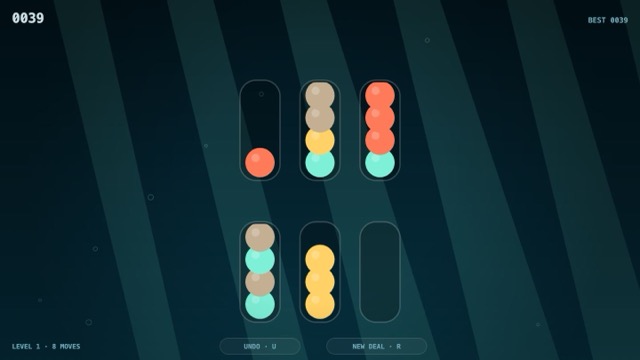
Tidewell
2DPour the top colour from one glass tube to another until every tube holds a single colour.
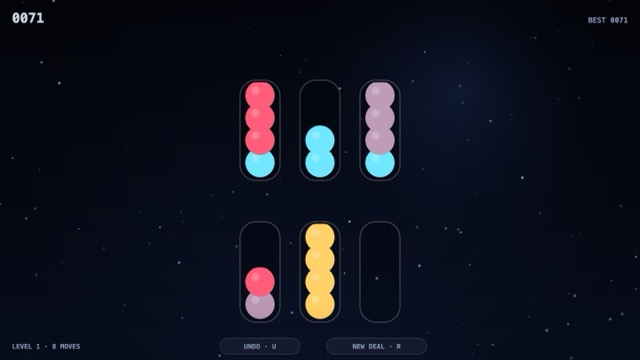
Orbit Vials
2DSort coloured marbles between glass vials, one colour per vial, before the empty space runs out.
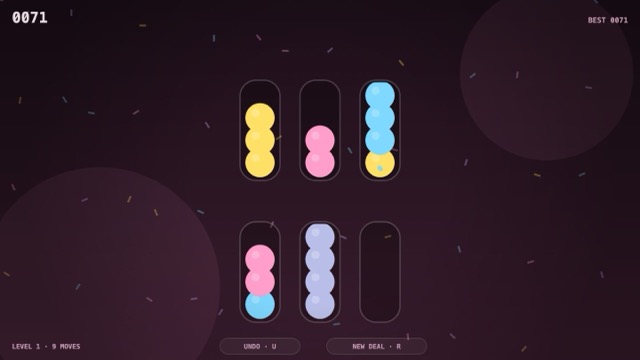
Pigment Press
2DPress pigment through a six-tube rack and pour each colour into its own can.
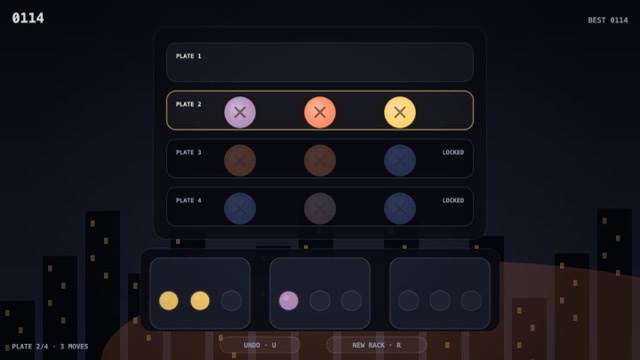
Bolt & Bin
2DUnbolt one plate at a time and bank matching bolts in three bins before the bins jam.
The six parts of a sort puzzle
Use these checks when the brief depends on a container rule. They matter less for a game where sorting is only a theme.
A stack you can read
Every container needs a visible order, bottom to top. If two colours can share a layer without a clear boundary, the player cannot plan the next pour.
A move that matches the container
The pour rule should follow from the container, not from a hidden combo. A single-layer pour and a matching-run pour are different puzzles.
Empty space as a resource
Empty containers are the workspace. The player needs to know how many moves of slack the board allows before a colour is trapped.
A bin that can jam
A limited bin adds a second constraint: the wrong colour can take the last slot. The jam should be visible before the player commits.
An undo that is part of the loop
Sorting puzzles invite experiments. Undo should be one input and should restore the exact prior stack, not a checkpoint.
A finish per container
The win state is each container holding one colour, or empty. A score that keeps running after the last pour hides the finish.
The full sort puzzle shelf
Browse all Sort Puzzle matches →| Build | Genre | Input |
|---|---|---|
| Tidewell | water sort puzzle | mouse or touch |
| Orbit Vials | ball sort puzzle | mouse or touch |
| Pigment Press | paint sort puzzle | mouse or touch |
| Bolt & Bin | screw sort puzzle | mouse or touch |
Swipe the table to see input.
Where a sort puzzle AI game maker stops
- Scoping one container, one move rule and a visible dead end.
- Comparing pour, run and bin sorting on one shelf.
- Checking whether undo is enough to recover.
- Generating solvable boards at every colour count.
- Building hundreds of levels with a difficulty curve.
- Selling a sorting game on art alone.
- Four browser builds, each with several levels.
- No level editor, daily challenge or hint economy.
- No claim that four builds cover every sort variant.
What sort puzzle tool pages promise
Tool pages promise endless colour-sort levels from a prompt. This shelf shows what the container, the move and the undo actually do.
| Part | Tool pages promise | What this shelf gives you |
|---|---|---|
| Level generation | A prompt can ask for endless colour-sort levels. | Each build deals a fixed rack and adds a colour every two levels. |
| Solvability | Rarely discussed in the promise. | Two empty containers and undo keep a bad deal recoverable. |
| Art | Often the main promise. | Water, marbles, pigment and bolts change the read, not the goal. |
Swipe the table to read all three columns.
How matching works
The matcher starts with “sort puzzle” and returns the closest playable build on this shelf. Read the matching method → Not sure which shelf fits?Open the genre map →
Sort Puzzle questions
What counts as a sort puzzle game here?
Sort puzzle here means moving a limited top layer between containers until each container is uniform. Four builds cover water, marbles, pigment and bolts. Three use pour-and-match tubes; one uses three bins and a plate stack. No match-3 or merge game is counted.
What is a sort puzzle AI game maker?
This is a reference shelf, not a level generator. Four builds let you compare how a move is limited by the container. The matcher picks the closest one so you can test the rule before you brief a model.
Can I make a sort puzzle game with AI?
Start with Tidewell for a single-layer pour, Orbit Vials for a run pour, or Bolt & Bin for a bin limit. Watch how the build shows a legal target and what happens when no container has room. That constraint is the brief.
Is there a sort puzzle game generator?
There is no generator on this page. A tool page can promise endless sorting levels; the shelf shows a dealt rack, a move count and an undo. That is enough to judge whether the rule is legible before you ask for more colours.
Are these sort puzzle games free?
All four builds are free in the browser, with no account or download. All three tube builds add a colour every two levels, starting at four; Bolt & Bin uses four colours across four plates and three bins.
Do sort puzzle games work on a phone?
The tubes are large tap targets, so all three pour games work on a phone. Bolt & Bin is the most precise because bolts are smaller. Start with Tidewell on a phone and check that the top layer is visible under your finger.
Which sort puzzle should I play first?
Play Tidewell, then Orbit Vials, then Bolt & Bin. The first limits the move to one unit, the second to a matching run, the third to a bin with three slots. Three builds show how much the container changes the puzzle.
Sources and definitions
- Puzzle video gameThe wider genre that contains colour sorting.
- Tower of HanoiThe stack-and-move ancestor of container sorting.
- SortingThe general idea of ordering items by a rule.