Part of the Puzzle shelf
Logic Puzzle AI game maker
A logic puzzle AI game maker has to make the rule and the dead end visible before it adds levels. This shelf has 11 builds: three sudoku grids, three screw-order puzzles, a packing board, a one-stroke water maze, a lantern slide, a merge board and a layer stacker. Try one before briefing a model to build a logic game.
What a logic-puzzle shelf has to prove
The first test is whether a legal move can be stated in one sentence. Sudoku Mini asks for a digit that does not repeat in a row, column or box; Flatpack asks for a polyomino that fits the remaining row; Liquid Maze asks for a single stroke that holds water. Across the 11 builds there are three groups: fixed grids, spatial packing and order puzzles, and each one shows its rule on the board rather than in a tutorial.
A shelf can reveal whether the board is readable, whether a wrong move is visible and whether the player can recover. It cannot show a hint economy, a daily puzzle service or a difficulty curve across hundreds of boards. Those are content and live-ops problems; a prompt cannot prove them.
All 11 builds are 2D and single-player: eight use mouse or touch, three use mouse or tap, and none needs a keyboard.
How this shelf was checked
- We checked every build in the table against the shelf gate: licence clear, loads clean, input works, loop starts, controls documented, and the page holds at 1440 px and 390 px.
- We read logic labels from the build’s own rule: a fixed grid (the three sudoku builds), a spatial fit (Flatpack, Forest Lights) or an order lock (Unscrew, Dream Logic, Magma Match).
- Quiz, trivia, sort and detective builds were excluded by tag and family; they have their own shelves.
- We checked the table against the build catalog on 23 November 2026. Counts in the title and table are the shelf count after those exclusions.
Shelf check log
| Build | What we ran |
|---|---|
| Mini Sudoku | Title → playing after Space; run clock +2.35 s; score 2; 0 console/network errors. |
| Flatpack | Title → playing after click; run clock +2.37 s; 0 console/network errors. |
| Unscrew | Title → playing after click; run clock +2.38 s; 0 console/network errors. |
Sample, not a full regression: three builds per shelf were loaded from the static build. Each moved from the title screen to playing after Space or a click, advanced its run clock and logged no console or network errors. Scores are whatever the build produced during the smoke test, not a skill rating.
Start with these builds
6 REAL BUILDS · NOT MOCKUPS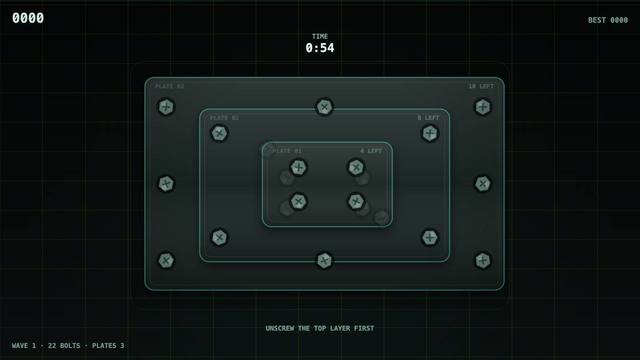
Unscrew
2DLoosen bolts in the correct order; one wrong pick jams the plate and blocks everything after it.
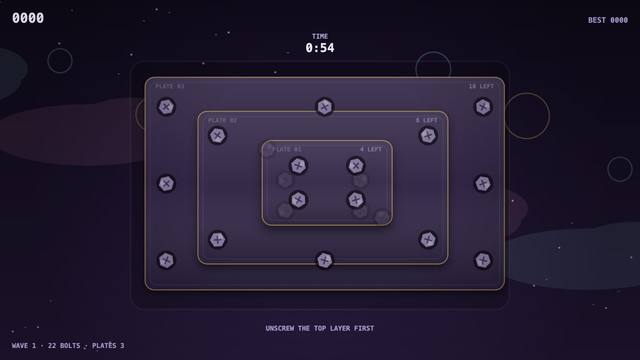
Dream Logic
2DTurn bolts out of stacked plates in the right order, and every plate you free shifts what stays reachable.
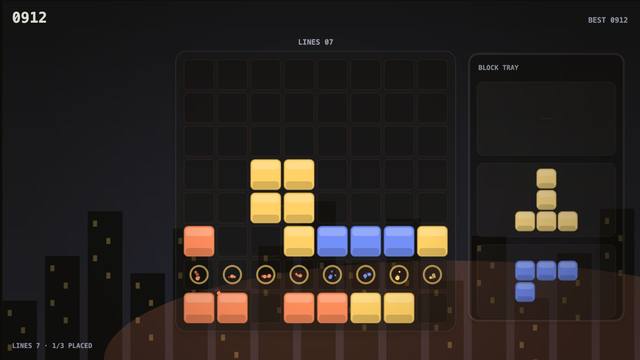
Flatpack
2DA warehouse of flatpack furniture and a van that is always one box too small. Rotate, stack and clear the grid without leaving a single shelf behind.
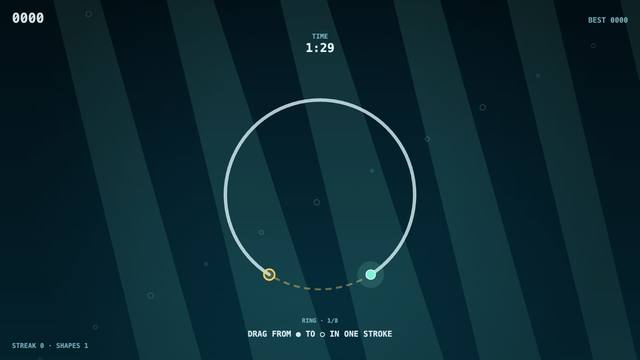
Liquid Maze
2DA cistern of half-built channels and a water level that does not wait. Draw the missing stroke, seal the route, and let gravity do the rest before the level rises.
Forest Lights
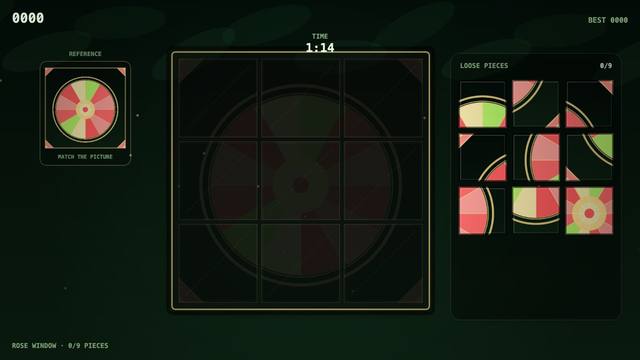
2DA forest floor scattered with lanterns and a picture that has come apart into tiles. Rearrange the glass, restore the pattern, and watch the trees light up in the right order.
Sudoku Classic
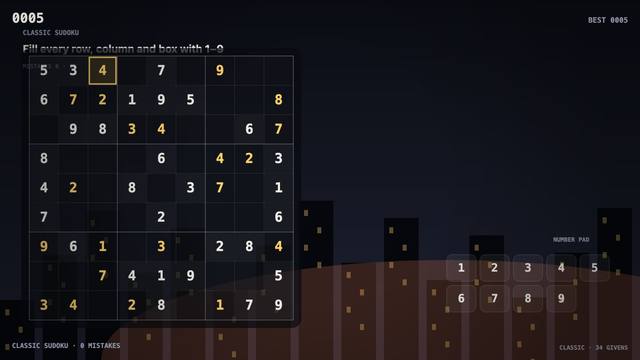
2DThe classic nine-by-nine sudoku, one fixed puzzle, and a mistake counter.
The six parts of a logic puzzle
Apply these tests when a brief depends on one explicit rule. They count less for a narrative game with a single locked door.
A rule you can state
The player should be able to say what a legal move does without opening a help panel. Sudoku Mini forbids repeats; Flatpack fits a polyomino; Liquid Maze accepts one stroke.
A board you can scan
The board is the state, so every cell needs enough contrast to compare at a glance. A grid that needs a legend on every move is a reading test.
An order that can jam
Order puzzles need a visible consequence for the wrong first move. If any bolt can come out first, the puzzle is only a tap sequence.
A correction path
Undo, clear or reset should be available when the rule allows it. A puzzle that hides its only correction is a memory test wearing a logic label.
A move count that means something
A move should map to a decision, not to every tap. The count is useful when the player can compare two routes through the same board.
A finish you can see
Solved, jammed and out of moves should be distinct states. A board that simply stops accepting input is unfinished.
The full logic puzzle shelf
Browse all Logic Puzzle matches →| Build | Genre | Input |
|---|---|---|
| Unscrew | order puzzle | mouse or tap |
| Dream Logic | logic puzzle | mouse or tap |
| Flatpack | puzzle | mouse or touch |
| Liquid Maze | puzzle | mouse or touch |
| Forest Lights | puzzle | mouse or touch |
| Sudoku Classic | sudoku | mouse or touch |
| Magma Match | puzzle | mouse or tap |
| Mini Sudoku | sudoku | mouse or touch |
| Sudoku Six | sudoku | mouse or touch |
| Snip & Sprout | puzzle | mouse or touch |
| Snack Loop | puzzle | mouse or touch |
Swipe the table to see input.
Where a logic puzzle AI game maker stops
- Scoping one rule with a board that shows a legal move.
- Comparing fixed-grid, packing and order puzzles on the same shelf.
- Checking whether the undo path is visible before the first mistake.
- Building a daily logic puzzle with saved streaks.
- Tuning hints for several rule families.
- Generating solvable boards at scale without a solver.
- Eleven short browser puzzles, all playable now.
- No daily challenge, hint economy or progress account.
- No claim that one build teaches the whole genre.
What logic puzzle tool pages promise
Tool pages promise a logic game from a prompt. This shelf shows what the rule, the board and the recovery path actually do.
| Part | Tool pages promise | What this shelf gives you |
|---|---|---|
| Rule generation | A prompt can request sudoku, sokoban or a packing grid. | Each build uses one fixed rule; you can test it on the first board. |
| Difficulty | Often described as adaptive or endless. | Board sizes are fixed; later levels add pieces or colours, not a hidden rating. |
| Hints | A tool may promise contextual hints. | Undo and reset exist; none of these builds has a hint button. |
Swipe the table to read all three columns.
How matching works
The matcher starts with “logic puzzle” and returns the closest playable build on this shelf. Read the matching method → Not sure which shelf fits?Open the genre map →
Logic Puzzle questions
What counts as a logic puzzle game here?
Logic puzzle here means a board with one explicit rule and a state that can become illegal: sudoku, packing, one-stroke routing, a sliding mosaic, a merge board, a layer stacker and three screw-order puzzles. Eleven builds, no quiz or detective games; those live on their own shelves.
What is a logic puzzle AI game maker?
This is a reference shelf, not a logic puzzle factory. The 11 playable builds let you compare how a rule is taught in the first move. The matcher points to the closest one, so you can test the rule before you write a generation brief.
Can I make a logic puzzle game with AI?
Start with Sudoku Mini for a fixed grid, Flatpack for packing, or Unscrew for order. Note how the build shows an illegal move and what undo costs. Put that recovery path in the brief; a model can generate more boards once the rule is pinned down.
Is there a logic puzzle game generator?
There is no generator on this page. A tool page can promise infinite logic levels; the shelf shows fixed boards, a move count and a reset. That is enough to judge whether the rule is legible, which is the part that usually breaks first.
Are these logic puzzle games free?
All 11 builds play in the browser at no cost, with no account and no download. Three are screw-order puzzles, three are sudoku, and the rest cover packing, one-stroke routing, a sliding mosaic, a merge board and a layer stacker. Start with the rule you already understand, then try one that is unfamiliar.
Do logic puzzle games work on a phone?
The sudoku grids and screw puzzles are comfortable on a phone; the packing and one-stroke boards need more precision. Sudoku Mini is the safest first tap test because the 4x4 grid fits without zooming. Check the target size before you judge the rule.
Which logic puzzle should I play first?
Play Sudoku Mini, then Flatpack, then Unscrew. The first shows a fixed rule, the second shows space running out, the third shows order locking the board. Three builds are enough to decide which logic loop you would brief.
References and definitions
- Logic puzzleThe puzzle family built around deduction rather than knowledge.
- SudokuThe no-repeat grid that anchors three builds here.
- SokobanThe crate-pushing rule behind the packing branch.