Part of the Puzzle shelf
Match-3 AI game maker
A match-3 AI game maker has to make swap board and timed board legible before it adds features. Match-3 is a grid you scan for a legal swap, then watch the cascade settle. Twelve boards here cover swap, timed and themed sets. Learn one board's rhythm before you brief a model on a new puzzle.
What a match-3 shelf has to prove
Scanning comes before strategy. A player should spot a legal swap without counting colors, follow a cascade to its end, and still know which piece moved. The boards here change size, clock and theme, yet each one is testing that same scan.
Twelve boards can prove a swap is legible and a chain feels earned. They cannot prove a hundred tuned levels, a progression curve or a content calendar. Those are production choices, not prompt settings.
Start with these builds
6 REAL BUILDS · NOT MOCKUPS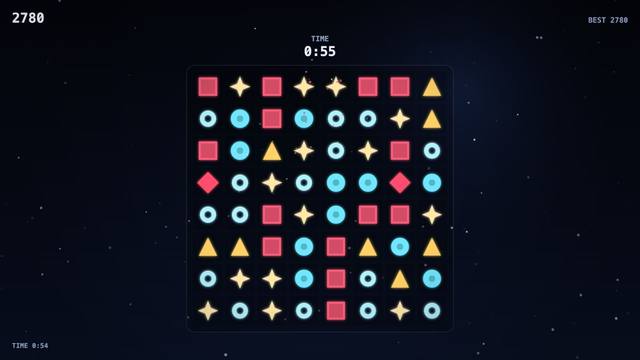
Star Swap
2DSwap neon tiles across an eight-by-eight starfield and stack chains before the sixty-second clock runs dry.
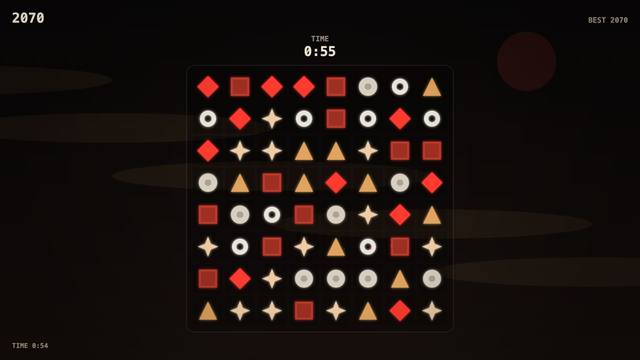
Crypt Match
2DMatch bone-white and blood-red tiles through candlelit fog while a sixty-second clock measures how long you last.
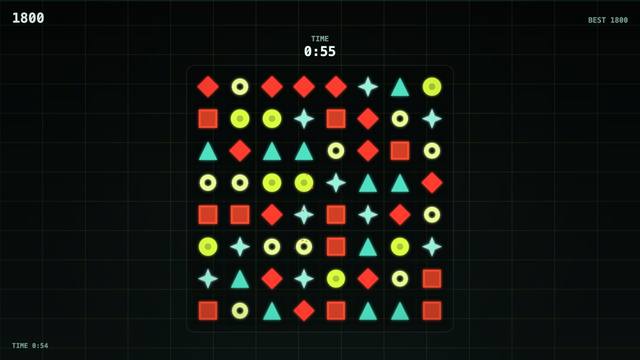
Chip Match
2DSixty seconds of acid-lime circuitry: swap adjacent tiles, clear lines, and let chains build the score.
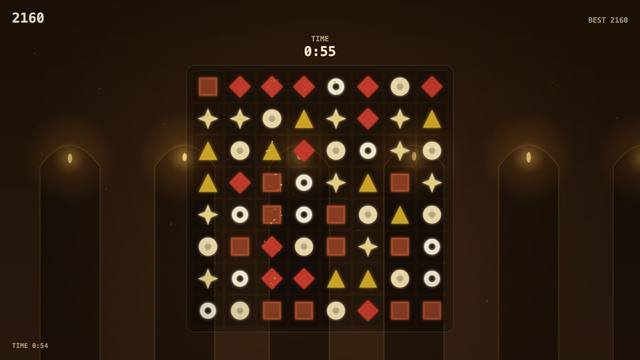
Rune Match
2DHeavy stone arches, parchment tiles, and a sixty-second clock: clear lines of three and keep chains alive.
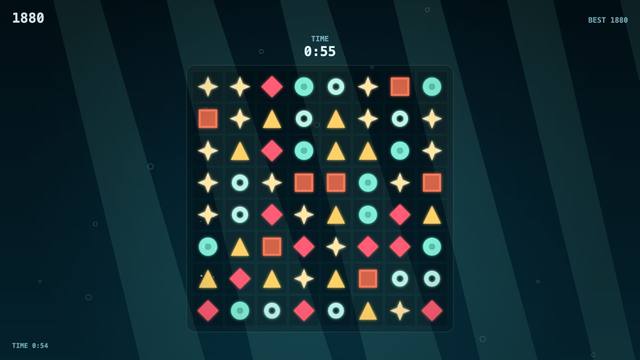
Pearl Match
2DBioluminescent tiles shift through deep teal water; swap them, clear lines, and score before the clock empties.
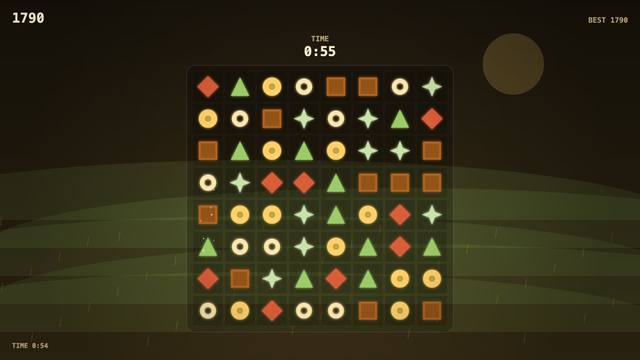
Crop Match
2DSwap wheat and barn-red tiles across an 8x8 field while a sixty-second clock drains and every chain you build buys you score.
The six parts of a match-3 board
These checks fit a swap-and-cascade brief. A story-first game that happens to use a board can ignore most of them.
A board you can scan
The player needs to see the grid without counting pixels. Piece shape and color should separate at a glance.
A legal swap
The game should show why a swap is allowed or rejected. A silent bounce teaches nothing.
A cascade that resolves
Chain reactions are the reward. The board should settle before the next input, or the player loses the thread.
A goal beyond the score
A timer or a move limit gives the board a shape. Without one, the player can drift.
A board that refills fairly
New pieces should not create an unwinnable board without a warning. The refill is part of the fairness contract.
A theme that stays out of the way
The theme should support the board, not hide it. A busy background makes the pieces harder to read.
The full match-3 shelf
Browse all Match-3 matches →| Build | Genre | Input |
|---|---|---|
| Star Swap | match-3 puzzle | keyboard or touch |
| Crypt Match | match-3 puzzle | keyboard or touch |
| Chip Match | match-3 puzzle | keyboard or touch |
| Rune Match | match-3 puzzle | keyboard or touch |
| Pearl Match | match-3 puzzle | keyboard or touch |
| Crop Match | timed match-3 | keyboard or touch |
| Metro Match | timed match-3 | keyboard or touch |
| Bloom Match | timed match-3 | keyboard or touch |
| Sugar Swap | timed match-3 | keyboard or touch |
| Medal Match | timed match-3 | keyboard or touch |
| Crush Hour | match-3 | mouse or touch |
| Match Corner | match-3 | mouse or touch |
Swipe the table to see input.
Where an AI match-3 game generator stops
- Scoping a first match-3 around one board and one goal.
- Comparing swap, timed and themed structures.
- Testing whether a cascade feels readable.
- Hand-tuning a hundred levels and difficulty curves.
- Building a meta progression, currency or event calendar.
- Proving retention without real player data.
- Twelve short browser boards with visible goals and restarts.
- No level editor, save system or monetization layer.
- No claim that any build is a complete commercial match-3.
What match-3 tool pages promise
Match-3 tools usually promise a puzzle from a prompt. This shelf shows what the board, the swap and the cascade actually do when you play.
| Part | Tool pages promise | What this shelf gives you |
|---|---|---|
| Board rules | A prompt can suggest a grid and a match length. | Every build has a fixed board you can test. |
| Cascade feel | Hard to judge until the board resolves. | You can see whether chains settle and stay readable. |
| Content volume | Generation can produce level variants. | Each build is one short board, not a level pack. |
| Full game | A tool may promise a complete match-3. | These are prototypes and small boards, not full products. |
Swipe the table to read all three columns.
How matching works
The matcher starts with “match-3 puzzle” and returns the closest playable build on this shelf. Read the matching method → Not sure which shelf fits?Open the genre map →
Match-3 questions
What counts as a match-3 game here?
Match-3 here is a grid you scan for a legal swap, then a cascade you follow to its end. Twelve boards cover swap, timed and themed sets. There is no level editor, save file or currency, so the shelf tests whether a chain stays readable and whether a dead board is obvious.
What is a match-3 AI game maker?
This is a twelve-board reference shelf, not a level generator. Each build fixes the grid and the goal, so you can compare how a legal swap is marked and how a cascade settles. The matcher returns one board from your brief, and you play one round before you commission a level pack.
Can I make a match-3 game with AI?
Play Star Swap and find a legal swap without counting colors. The shape and the color should both separate at a glance. Write that scan into the brief as the first test. A model can add levels later, but it cannot hand-tune a difficulty curve it has never played.
Is there a match-3 game generator?
No generator on this page. A tool page can suggest a grid and a match length; the shelf shows twelve fixed boards and the moment a cascade stops being readable. The missing part is the hundred-level curve, the meta progression and the event calendar, and those are production choices.
Are these match-3 games free?
All twelve boards are free browser builds. No account, no download and no ad gate; keyboard and touch both work. Remix and export are not open yet. Play Star Swap first, because the shelf is for testing a scan, not for replacing a live match-3 service.
Do browser match-3 games work on a phone?
They work on a phone with touch, and a small board fits the screen. Star Swap is the best first test because the six pieces separate by shape; Crypt Match is easier on a larger screen when the themed background competes with the board. Check the swap targets before you judge it.
Which match-3 games should I play first?
Start with Star Swap for the clean board, then Crypt Match for the themed set. Chip Match and Rune Match add different piece languages. Two boards are enough to see whether the shelf is testing a cascade or just a palette; write down which scan you would brief.
Sources and definitions
- Match-3Genre definition and common board rules.
- Puzzle video gameContext for timed and untimed puzzle loops.