Part of the Educational shelf
Memory Game AI game maker
A memory game asks the player to hold a layout in their head and act before it fades. This shelf has 4 browser builds: three card-matching tables and one fogged maze. Play one round before you ask a model to design a recall loop.
What a memory game shelf has to prove
The first test is the reveal. A card should turn over cleanly, stay visible long enough to register and hide again without a flicker. Reef Memory, Midway Memory and Ruin Memory use the same turn-two-cards rule but change the art, the timer and the pressure.
The second test is the route back. A memory game is not only recall; it is the decision to spend a turn on a pair you half-remember. Volcanic Maze moves that decision into space: the fog hides the map, and every wrong turn costs time. The shelf is small on purpose. It can show whether a reveal, a timer and a recall loop read; it cannot show a campaign or a memory-training curriculum.
Start with these builds
4 REAL BUILDS · NOT MOCKUPS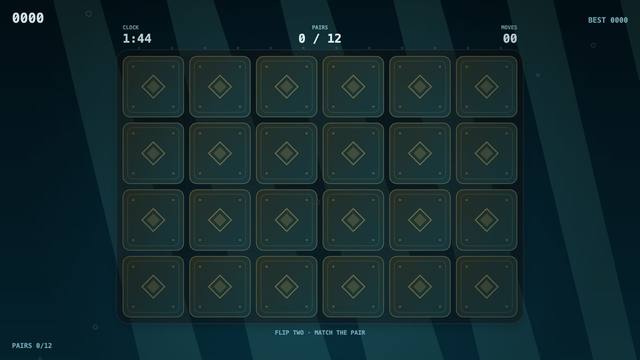
Reef Memory
2DFlip cards in a bioluminescent reef and pair matching tiles before the clock runs out.
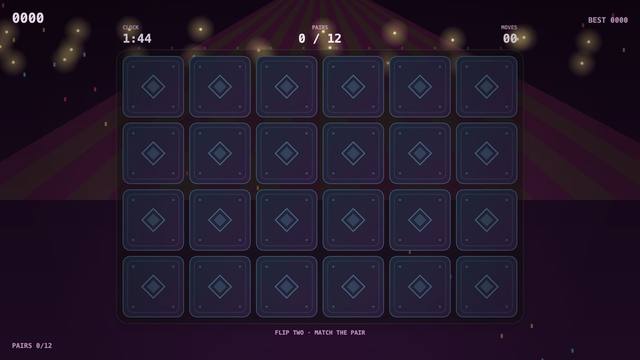
Midway Memory
2DFlip cards in bulb gold and candy pink, holding the pair positions while the clock runs down.
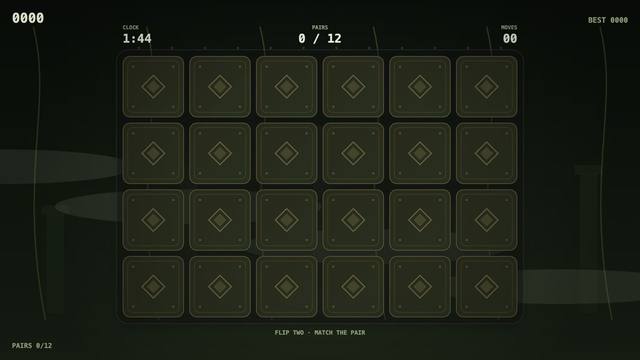
Ruin Memory
2DTurn two cards at a time and keep the layout in your head before the timer closes the round.
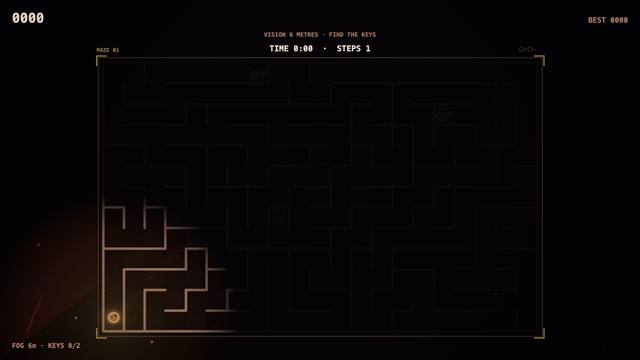
Volcanic Maze
2DMove through a fogged basalt maze where only a short radius of lava glow is visible, and every wrong turn costs time.
The six parts of a memory loop
Use these six checks when the brief depends on a reveal, a timer and a recall choice. They matter less for a story game where memory is only a narrative theme.
A reveal you can register
The card face needs enough time and contrast to be read before it hides. A flip that is too fast turns the game into a click race.
A layout worth holding
The pairs should be distinct at a glance. If every card shares a silhouette, the player is memorising positions without a handle.
A timer with a reason
A clock should create a decision, not a panic. The player needs to know whether the timer ends the round or only scores it.
A wrong turn with a cost
A mismatch should cost a turn or a little time; a wrong path in a maze should cost distance. The price should be visible before the choice.
A route back
A memory game needs a way to recover: a new deal, a hint or a clear restart. Without it, one bad round becomes the whole session.
A finish you can see
The last pair or the exit should stop the round and say so. A silent finish leaves the player unsure whether the game is over.
The full memory game shelf
Browse all Memory Game matches →| Build | Genre | Input |
|---|---|---|
| Reef Memory | memory game | mouse or tap |
| Midway Memory | memory matching | mouse or tap |
| Ruin Memory | memory puzzle | mouse or tap |
| Volcanic Maze | maze puzzle | keyboard or touch |
Swipe the table to see input.
Where this memory shelf stops
- Judging a reveal, a timer and a recall choice in a short round.
- Comparing three card-matching tables with one fog-memory maze.
- Checking whether a wrong turn has a visible cost.
- A memory-training curriculum or a difficulty curve across weeks.
- A story campaign, a collection system or online leaderboards.
- A neuroscience claim about improving memory in daily life.
- Four short browser rounds: three card tables and one fog maze.
- A timer, a mismatch cost and a clear restart.
- No curriculum, no campaign and no clinical claim.
Where these rounds sit beside a memory-training app
A training app starts with a programme, a baseline and a progress chart. These four builds start with one round and one recall choice. The gap is the point.
| Part | Tool pages promise | What this shelf gives you |
|---|---|---|
| Programme | A daily plan, levels and a progress chart. | One short round per build. No plan. |
| Scoring | Accuracy, reaction time and a history. | A round result. No long-term history. |
| Content | Dozens of card sets and difficulty tiers. | One art set and one rule per build. |
| Claim | Often promises cognitive improvement. | A game to play, not a clinical claim. |
Swipe the table to read all three columns.
How matching works
The matcher starts with “memory game” and returns the closest playable build on this shelf. Read the matching method → Not sure which shelf fits?Open the genre map →
Two rounds to study
Memory Game questions
What is a memory game AI game maker?
It is a four-build reference shelf for recall loops: three card-matching tables and one fogged maze. It is not a memory-training programme.
Can I make a memory game with AI?
Describe the reveal first: how long a card stays visible, what makes a pair distinct and what a mismatch costs. A model can draft a rule; these builds show whether the loop reads.
Is there a memory game generator?
No. Four fixed rounds let you compare reveal time, timers and recall costs. They do not generate a card set or a curriculum.
What counts as a memory game here?
A hidden layout, a reveal and a recall choice. 4 builds are card-matching tables; the fourth is a fogged maze where the map itself is the memory test.
Are these memory games free?
Yes. All four open in the browser with no account, install or ad before the first round.
Do these memory games work on a phone?
Yes. The three card tables use tap, and Volcanic Maze uses swipe. The card tables are the easiest on a narrow screen.
Do these games improve memory?
They exercise recall inside the game. The shelf makes no claim about improving memory in daily life, and it is not a clinical tool.
Sources and definitions
- Memory gameDefinition and common variants.
- MazeThe spatial-recall branch.