Part of the Adventure shelf
Hidden Object AI game maker
A hidden object AI game maker has to make detective scenes and pastel search legible before it adds features. A hidden-object game asks you to find a named thing in a busy scene. This shelf has 6 builds: four detective scenes, a pastel feeling hunt and a volcanic search run. Play one before you ask a model to fill a room with objects.
What a hidden-object shelf has to prove
The first test is whether the named object is visible once you know where to look. A scene can be dense without being unfair: the target should sit against a contrasting edge, cast a readable shape and avoid sharing a silhouette with three decoys. The 6 builds here vary the scene and the pressure. The detective cases give you a clue list; Find the Feeling asks you to search a pastel room; Ash Delve turns the search into a short roguelike run.
A shelf can show whether the object placement, the clue list and the search cost are legible. It cannot show a hand-painted season of scenes, a hint economy tuned over millions of players or a story that justifies every room. Those are art, live-ops and writing problems.
Start with these builds
6 REAL BUILDS · NOT MOCKUPS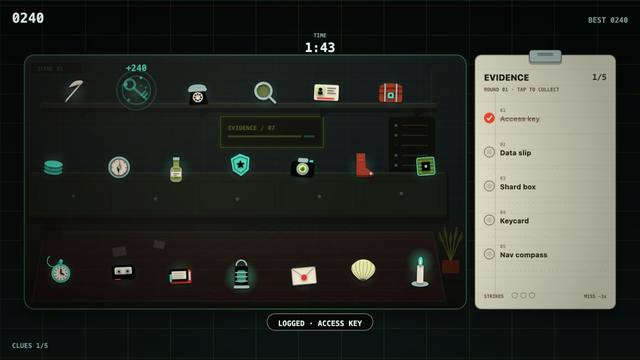
Data Detective
2DSearch black-glass cyberpunk rooms for named objects before the timer drains and wrong taps add strikes.
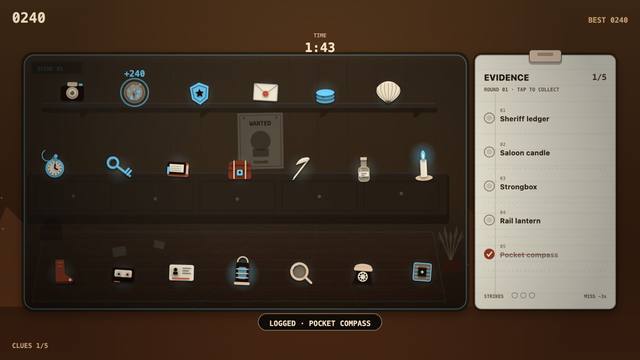
Dust Alibi
2DInspect a dust-worn wildwest room for named objects before time runs out and strikes pile up.
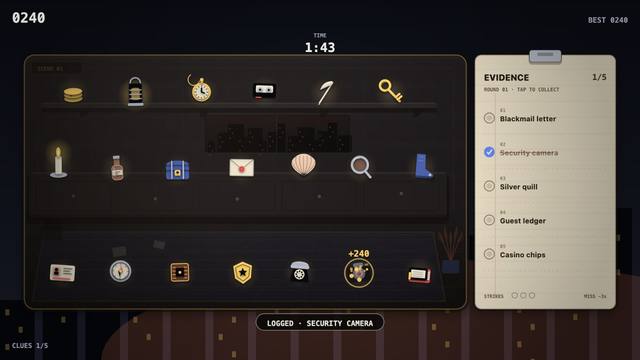
Penthouse Clue
2DSweep a penthouse interior for the named objects on your list while the clock and strike count tighten.
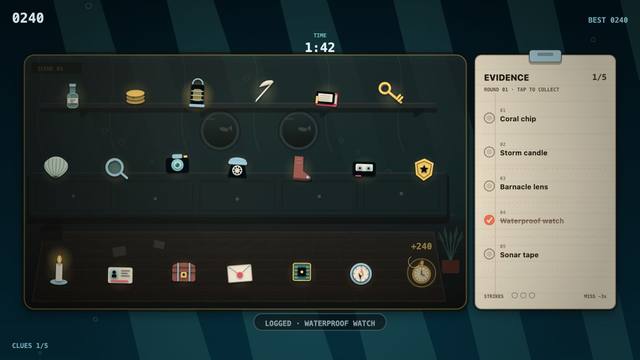
Reef Case
2DFind each listed object in a teal reef scene before the timer drains and strikes end the run.

Find the Feeling
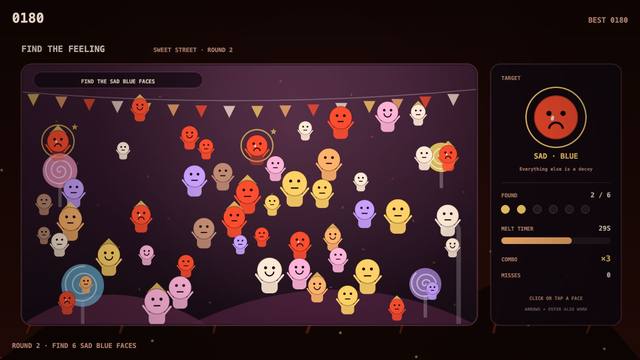
2DSearch pastel candy rooms for a hidden feeling; each miss leaves less room to check.
Ash Delve
2DHunt hidden objects through charred basalt rooms, where a wrong turn burns the run down
The six parts of a hidden-object scene
Use these checks when the brief depends on searching a static scene. They matter less for a story adventure where objects are used rather than hunted.
A target you can name
The clue list has to use the same noun the scene shows. A request for a 'key' should not point at a key-shaped brooch the player can only call jewellery.
A scene with layers
Foreground, middle ground and background give the eye somewhere to travel. A flat wallpaper of objects turns the search into a scan line.
Decoys with a reason
A decoy should share a colour or shape with the target, not just exist. The player should feel tricked by a plausible neighbour, not by noise.
A search cost
A timer, a move limit or a short run gives the search weight. Without a cost, the player can sweep every pixel until the scene gives up.
A clue list you can trust
Found objects should disappear from the list or clearly mark themselves. A list that never updates makes the player re-check the same corner.
A payoff for the last object
The final find should open the next scene, explain the case or close the run. A silent counter is not a finish.
The full hidden object shelf
Browse all Hidden Object matches →| Build | Genre | Input |
|---|---|---|
| Data Detective | hidden object mystery | mouse or tap |
| Dust Alibi | clue-finding mystery | mouse or tap |
| Penthouse Clue | search and find | mouse or tap |
| Reef Case | hidden object | mouse or tap |
| Find the Feeling | hidden object | mouse or tap |
| Ash Delve | hidden object roguelike | keyboard or touch |
Swipe the table to see input.
Where an AI hidden object game generator stops
- Scoping a single scene around one clue list and one search cost.
- Comparing case scenes, a pastel search and a search roguelike.
- Checking whether a target is visible without being obvious.
- Painting a season of scenes with a consistent art direction.
- Tuning a hint economy and a difficulty curve over many rooms.
- Writing a mystery that makes every found object matter.
- Six short browser searches with visible clue lists.
- No voice acting, scene packs or season-long case files.
- No claim that any build is a complete hidden-object adventure.
What hidden object tool pages promise
Tool pages promise a scene from a prompt. This shelf shows what the player actually has to notice, name and search under pressure.
| Part | Tool pages promise | What this shelf gives you |
|---|---|---|
| Scene generation | A prompt can describe a room and a list of objects. | Every build has a fixed scene you can inspect for clutter and contrast. |
| Object placement | Hard to judge until the generated scene is played. | You can check whether the named target is visible and the decoys are plausible. |
| Search cost | Often left as a timer setting. | Each build has a fixed run, life or case cost. |
| Full game | A tool may promise a complete casual game. | These are short scenes, not a season of content. |
Swipe the table to read all three columns.
How matching works
The matcher starts with “hidden object mystery scene” and returns the closest playable build on this shelf. Read the matching method → Not sure which shelf fits?Open the genre map →
Hidden Object questions
What counts as a hidden object game here?
Hidden object here means a named target in a fixed scene, with a clue list and a cost for searching. 6 builds cover four detective desks, a pastel feeling hunt and a volcanic run. There is no season pass or hand-painted scene pack; the shelf is a test of placement, contrast and search cost.
What is a hidden object AI game maker?
It is a small scene shelf, not an art generator. 6 builds let you compare how a target is hidden, how a clue list is worded and how a timer or a run changes the search. The matcher picks the closest scene so you can inspect the placement before you brief a model.
Can I make a hidden object game with AI?
Start with Data Detective and find one named object without using a hint. Then write down why it was visible: the edge, the colour or the shape. That sentence is the placement rule your brief needs. A model can paint more rooms later; it cannot guess the contrast that makes a search fair.
Is there a hidden object game generator?
No generator here. A tool page can promise a room full of objects; the shelf shows whether the target is visible without being obvious and whether the decoys are plausible. Those are the two failures that make a hidden-object scene feel cheap, and you can see both in one run.
Are these hidden object games free?
All six searches are free browser builds. No signup, no download and no ad gate; mouse and touch work. Remix and export are not open yet. Play one scene first, because the shelf is a test of placement and search cost, not a content library.
Do browser hidden object games work on a phone?
They work with mouse or touch, and a phone is fine for a single scene. Data Detective is the best first test because the clue list is compact; Find the Feeling is easier on a larger screen when the pastel palette is dense. Check whether the target is still visible at phone size.
Which hidden object games should I play first?
Begin with Data Detective, then Find the Feeling. The first shows a desk search; the second shows a mood search without a crime. Ash Delve adds a run cost. Two scenes are enough to see whether the shelf is testing placement or just clutter.
Sources and definitions
- Hidden object gameGenre context for scene search and clue lists.
- Puzzle video gameThe broader puzzle category this shelf sits inside.